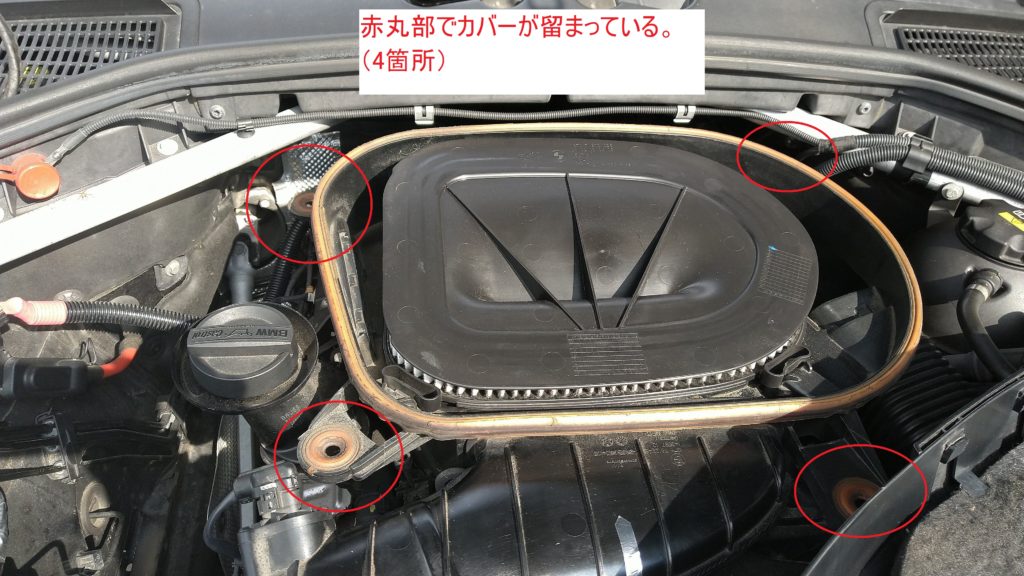
I swapped my BMW X3 (F25) over to its winter tyres the other day. While the wheels were already on my mind, I fitted an AliExpress TPMS I had bought to try out. Here is how the first ten days went.
What a TPMS does
TPMS stands for Tire Pressure Monitoring System. It watches the pressure in each tyre and warns the driver when something is off. More and more premium cars come with one from the factory.
The basic idea:
- A transmitter on (or built into) each valve measures pressure plus temperature directly inside the tyre
- The readings go to a receiver in the car, shown on a monitor or warning light for the driver
- It keeps an eye out for punctures, overheating and other tyre problems all the time
The AliExpress TPMS I bought
The kit I bought for the F25 cost under ¥2,000 (about $13) on AliExpress, shipping included.
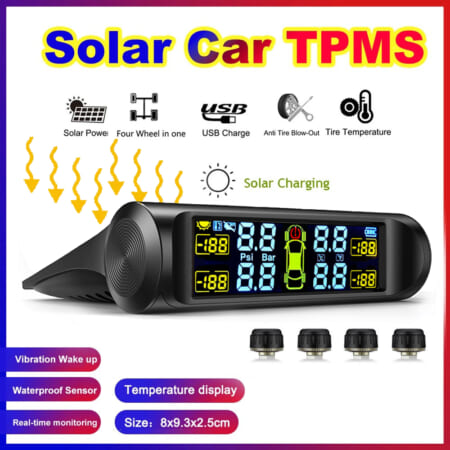
The display charges itself from a small solar panel, so it needs no power lead. The sensors are external ones that screw on in place of the valve caps.
A USB charging cable came in the box too. If your car lives outdoors like mine, though, it seems to manage fine on solar alone.
Similar kits are sold on Amazon Japan, but they cost more than on AliExpress.
Fitting it to the car
Right after the winter tyre swap, I fitted the TPMS I had waiting.
Sensors on the tyre valves
Each sensor goes onto a tyre valve, where you would normally attach an air pump.
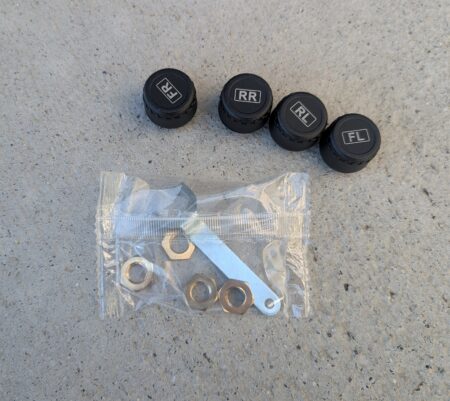
Each sensor is marked with the wheel it belongs on.
Take off the original valve cap, slip the anti-rotation lock ring on first, then screw on the sensor for that wheel position. You will not need the original caps anymore. I put mine away somewhere safe.
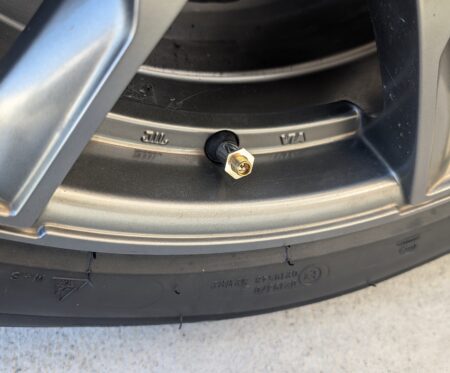
Original cap off, lock ring on first.
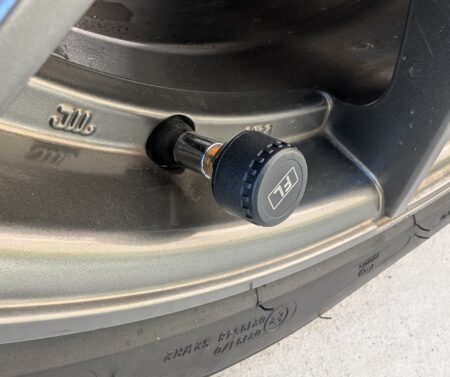
The external sensor goes on where the cap used to be.
These sensors read the pressure directly, so if you fumble while screwing one on, you get a hiss of escaping air.
Once it is on, though, nothing leaks. I hand-tightened the lock ring up against the sensor, and after that I could not remove the sensor by hand.
The display sits on the dashboard
With all four sensors fitted, I switched the display on. After a while, readings for each tyre started to appear.
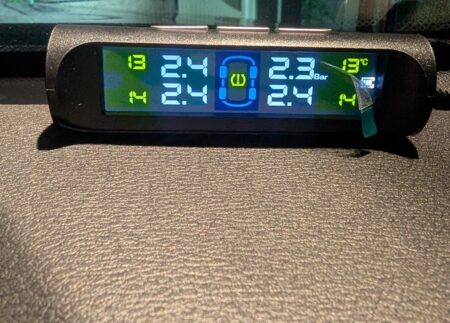
It took about 15 minutes before all four wheels showed up.
First impressions
An English manual was included, but I worked out the settings just by poking at the buttons.
You can set the warning thresholds. To begin with, I set the high alarm at 3.0 bar. I set the low alarm at 2.1 bar.
How it looks
The sensors are bigger than normal valve caps, so they look a bit clunky. On darker wheels the black sensors hardly stand out, so it does not bother me.
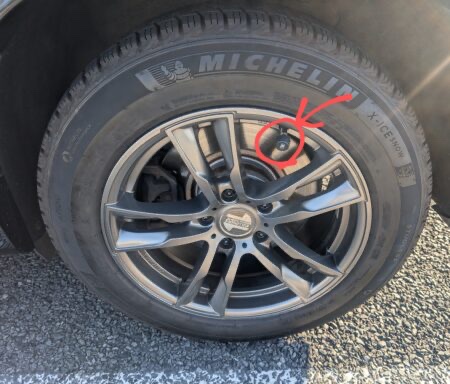
That is the sensor. Quite a bit bigger than a standard cap.
How it works day to day
The display on the dashboard refreshes each wheel roughly every 10 minutes.
It seems to switch itself on when it feels the car vibrating, and the screen goes dark while the car is parked.
As soon as you drive off, or touch the unit, it lights up with pressure plus temperature for every wheel. In use it feels completely natural.
What bugs me
Because each wheel only refreshes every 10 minutes or so, the readings can look out of step for a while when temperatures change quickly.
This is most obvious after the car has been parked for a bit. Each tyre changes as its own new reading arrives, so the four numbers look oddly mismatched until all of them have refreshed.
I expect I will get used to it. If nothing else, it showed me how much tyre temperatures really swing.
Setting the alarm threshold
After the winter tyre swap I set the pressures to 2.8 bar. Then, after a daytime run on the expressway, one tyre climbed to 3.0 bar. The unit went “beep beep beep.”
I had the high-pressure alarm set at 3.0 bar. Pressure seems to move by around 0.3 bar with temperature changes while driving. So I have now raised it to 3.2 bar.
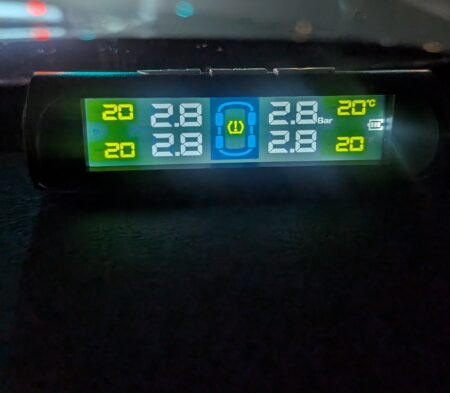
I run 2.8 bar cold, for fuel economy.
At least I now know the alarm really does sound.
Topping up the air
To add air, you have to take the sensor off, which needs the small spanner supplied with the kit to turn the lock ring.
After doing one wheel, I did not find it much of a hassle. I only check pressures every month or two, so taking the sensors off then should be no bother.
Once you are used to it, it is easy. You just need to keep that spanner in the car.
Does it affect the drive?
Each tyre now carries a sensor that is heavier than a normal valve cap, so the wheel balance must be slightly off. So far I have not felt anything odd while driving.
The benefit of spotting abnormal pressure straight away seems far bigger.
Would I recommend an AliExpress TPMS?
If someone asked me whether to buy an aftermarket TPMS, I would say I do not know yet.
If it keeps working without problems for at least six months, until the next tyre swap, then I think I can recommend it.
Ten days in, the display runs on solar with no wiring, the sensors read properly, and there are no air leaks. So far, so good.
I will keep an eye on it for a while. If you are curious about an aftermarket TPMS, even a cheap one like this works properly, so it may be worth a try.
This article is also available in Japanese.