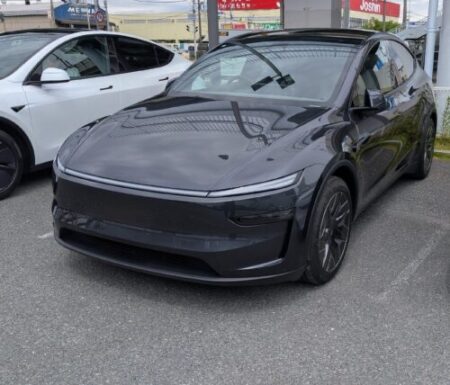
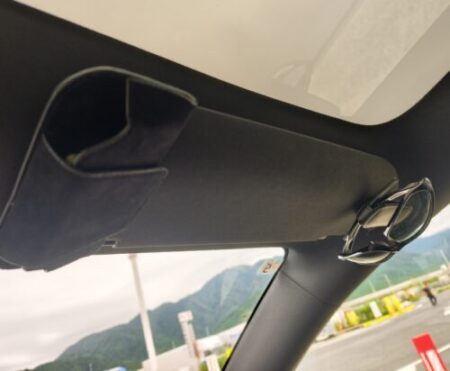
The night I crossed 10,000 km, my Model YL was sitting at 4% state of charge. That was deliberate: I wanted to measure the Model YL charging curve starting from as low as I dared take it.
Drive 10,000 km in two months and you develop a feel for how fast the battery drains. On the previous charge I put in just enough for two commutes, which left me arriving at the Supercharger with almost nothing in reserve.
Low state of charge means fast charging. So if I was going to be down there anyway, I decided to record the whole session screenshot by screenshot, from the moment I plugged in until I unplugged.
Peak was 251 kW. What surprised me was how long it stayed there.
You can see how the car got to 10,000 km in my two-month efficiency report.
Arriving at the Supercharger With 4% Left
The app showed 4% on arrival, in red, with a low power warning.

The app is in Japanese. The red banner reads “Low Power Mode”.
My lowest ever is 3%, so this was not a record, but it is still low enough to make some people uncomfortable.
The Model YL uses an NMC (nickel manganese cobalt) lithium-ion pack from LG Energy Solution. Testers in Japan have driven these well past an indicated 0%, so there is real margin below the display. Knowing that margin exists is why I am happy to run it this low.
I left my charge limit at its usual 75% and plugged in.
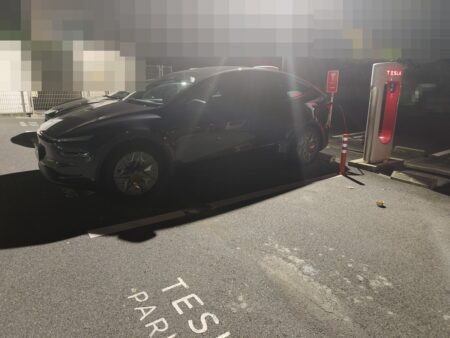
Two of the four stalls were occupied, including mine. The other car was near the end of its session, so its draw would have been low. In other words, almost nothing was limiting my share of the cabinet.
251 kW From the Moment I Plugged In
The session started at 20:42:49. Power jumped straight to 251 kW.
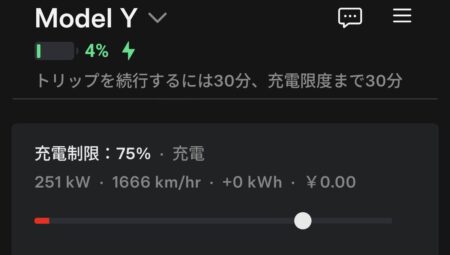
Every screenshot in this article carries the same two Japanese status lines under the battery. They read “Time to resume trip: N min / Time to charge limit: N min”, then “Charge limit: 75% · Charging”.
Alongside it the app claimed 1,666 km/hr. Keep that rate up for an hour and you would add 1,666 km of range.
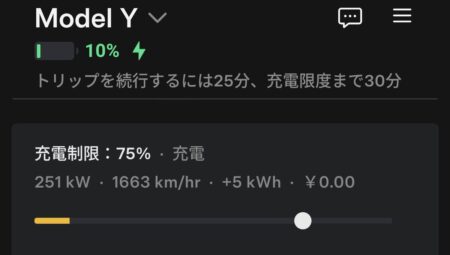
The next screenshot is 20:44:12. Eighty-three seconds after plugging in, the battery had gone from 4% to 10%, taking on 5 kWh.
Power was still 251 kW. Not a single kilowatt had dropped off.
240 kW Held All the Way to 17%
At three minutes eleven seconds, with 17% showing, output was 243 kW.
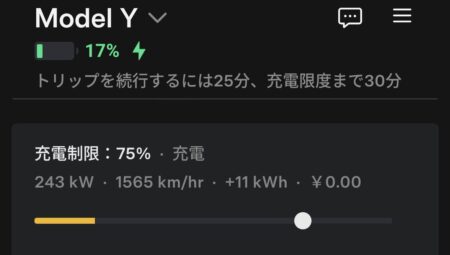
That is 11 kWh in the bank. A typical 3 kW AC charger would need about three hours forty minutes to deliver the same amount.
Then 18% arrived, and power dropped to 230 kW.
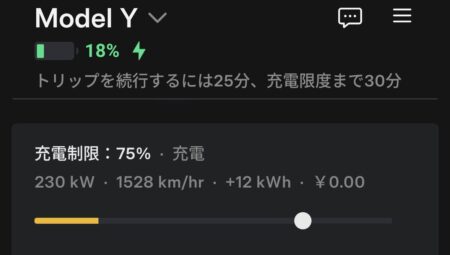
So the first shelf sits somewhere around 17% to 18%. That is as far as this car will use the top end of a V3 Supercharger.
Past 20% the Curve Steps Down
This is where it got interesting. Power did not fall in a straight line. It stepped down, wobbling up between steps.
After the drop to 230 kW at 18%, it recovered slightly to 238 kW at 19%.
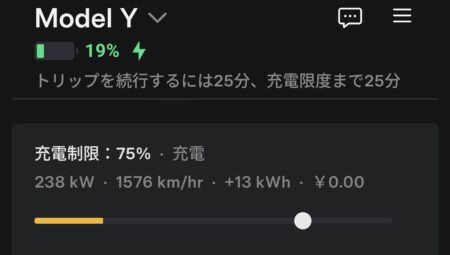
Then 235 kW at 20%, 225 kW at 21%. A slow slide with occasional recoveries.
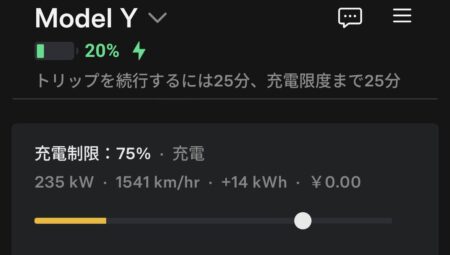
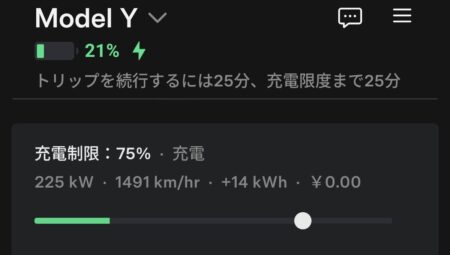
None of this is visible if you glance at the screen occasionally. It only appears when you line up screenshots taken roughly fifteen seconds apart.
At 22%, power fell hard to 186 kW.
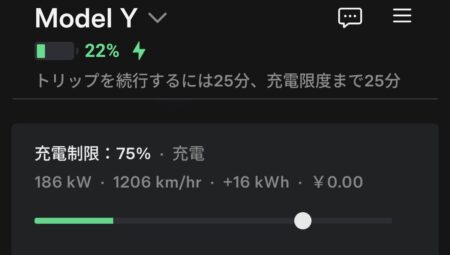
Breaking below 200 kW happened four minutes twenty-one seconds in. That was the second shelf, much more definite than the first.
The Measured Model YL Charging Curve (23 July 2026)
Every value below comes off the screenshots.
| Elapsed | SOC | Power | Cumulative |
|---|---|---|---|
| 0:00 (start) | 4% | 251 kW | +0 kWh (±0%) |
| 1:23 | 10% | 251 kW | +5 kWh (+6%) |
| 3:11 | 17% | 243 kW | +11 kWh (+13%) |
| 3:18 | 18% | 230 kW | +12 kWh (+14%) |
| 3:32 | 19% | 238 kW | +13 kWh (+15%) |
| 3:47 | 20% | 235 kW | +14 kWh (+16%) |
| 4:06 | 21% | 225 kW | +14 kWh (+17%) |
| 4:21 | 22% | 186 kW | +16 kWh (+18%) |
| 20:19 | 57% | 112 kW | +45 kWh (+53%) |
Laid out like that, the headline is the first block: 16 kWh in four minutes twenty-one seconds, taking the pack from 4% to 22%.
One caveat. This is an NMC car. Trims built around LFP (lithium iron phosphate) chemistry behave differently, so plugging in at the same state of charge will not give you the same shape.
20 Minutes for +45 kWh
The last screenshot is 21:03:08, twenty minutes nineteen seconds after the start.
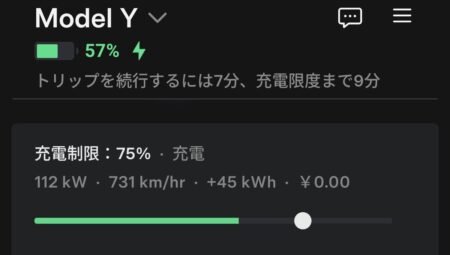
57% showing, power down to 112 kW, 45 kWh cumulative. Nine more minutes to reach my 75% limit.
The price in the bottom right stayed at ¥0.00 the whole session. My car came with three years of free Supercharging, so those 45 kWh cost nothing.
Split the session in half:
- First half (4% to 22%, 4:21): +16 kWh, averaging about 220 kW
- Second half (22% to 57%, 15:58): +29 kWh, averaging about 109 kW
Low state of charge gives you the whole first block at once. Past 20%, average power halves. This is exactly why frequent short stops beat one long one on a road trip.
Finishing Early Also Frees the Stall
Knowing your curve does more than shorten your own stop.
Superchargers are finite, so busy sites build queues. Sitting there at half power adds range slowly while somebody waits. Taking what you need during the fast block puts the next car on the plug sooner.
Measure your own car once, and you can answer “how long until I have enough” without guessing. The choice between staying plugged in versus leaving stops being a hunch.
Summary: Plugging In Below 10% Really Is Fast
What the session showed about the Model YL charging curve:
- Plugged in at 4%, saw 251 kW immediately
- 251 kW held at 10%, still 243 kW at 17%
- From 18% the curve stepped down, reaching 186 kW at 22%
- 4% to 57% in twenty minutes nineteen seconds, +45 kWh
This run happened to start at 4%, but anything in single digits should look similar. Running a battery that low feels risky before you have a sense of the car. After 10,000 km I can read “this driving style, this much range left” well enough to aim for it on purpose.
As a test case it could hardly have been better. Twenty minutes for more than half the pack means that on a long trip, short stops below 20% beat waiting around for 80%. I now believe that from the numbers rather than from feel.
Behaviour will shift with cabinet sharing, hardware version, temperature. I plan to measure those separately.
Two road trip stops where the curve met reality: an hour at Matsumoto, then the queue at Karuizawa.




This article is also available in Japanese.