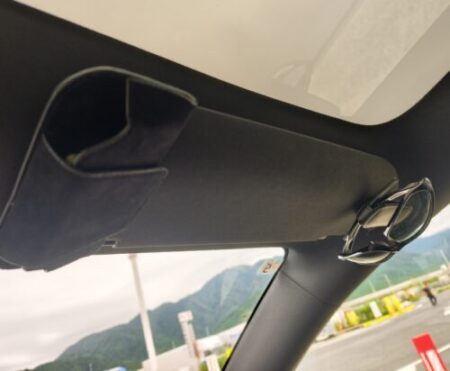
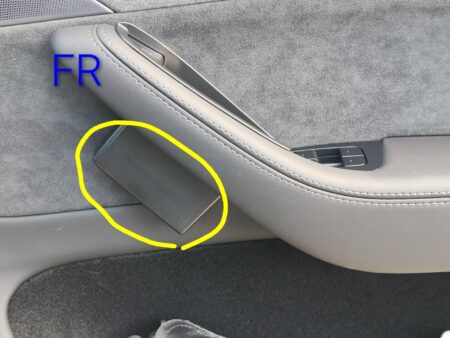
On May 23rd, a brand-new Tesla Model YL joined our household.
It’s the successor to my BMW F25 X3, which I finally let go after driving it for 500,000 km (about 310,000 miles). I wrote about selling the X3 in a separate post — currently available in Japanese only.
I honestly meant to write this up right after delivery, but somehow more than a month slipped by.
A new car comes with a surprising amount of homework, and before I knew it, here we are.
Better late than never — here’s a record of delivery day.
For those unfamiliar: the Model YL is the long-wheelbase, 3-row, 6-seater version of the Model Y. As of this writing it’s sold in a limited number of markets, Japan being one of them.
Why this car out of all the EVs available? That’s a long story I’ll save for another post.
We already run a BYD ATTO 3 as our second car, so the upsides and quirks of EV life are nothing new to us.
This wasn’t a “first EV” moment — it was more like “adding another EV to the fleet.”
And with that experience behind us, my honest conclusion was that this is the best EV you can buy in Japan right now, all things considered.
The Model YL takes over the X3’s old job: my daily commuter. Which means the odometer is about to start climbing fast.
Delivery Day Was Almost Comically Quick
The pickup location was Tesla’s Toyonaka Service Center, in the suburbs of Osaka.
It’s about an hour and a half from home by train and on foot, so I headed out alone to collect the car.
I rarely ride trains these days, so the trip itself felt like a little field day.
Tesla doesn’t do delivery ceremonies. That’s worth a note for readers outside Japan: at a traditional Japanese dealership, taking delivery of a new car is a bit of an event — a dedicated appointment, a salesperson walking you through everything, sometimes even a cloth-reveal moment and flowers. Tesla skips all of that.
When I arrived, the parking lot was lined with row after row of Teslas, and one of them was my Model YL.
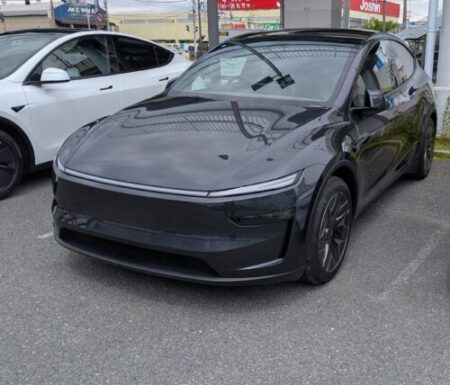
First meeting. In person, it looked far more imposing than in photos.
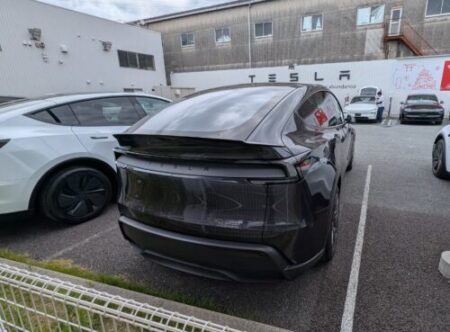
The paperwork took no time at all, and then it was basically “there you go.”
Compared with all the back-and-forth I remember from buying the BMW, it was almost anticlimactic.
I had expected something like this, but even so — the whole handover was done in about ten minutes.
The staff member who helped me looked visibly worn out.
Curious, I asked how many cars they deliver per day. The answer: “More than twenty. Every day…”
Part of the rush was a Tesla Japan promotion: cars delivered by the end of June came with three years of free Supercharging. That deadline clearly had Teslas flying out the door.
If an Osaka store is moving that many cars, I can only imagine what Tesla’s big delivery hub in Ariake, Tokyo looks like.
With the next customer’s delivery already queued up behind me, there was no reason to linger.
The staff member walked me through setting up my phone as the key, and that was it.
I wished him luck, and he was off to prep the next car.
So I kept the on-site fiddling to a minimum and decided to figure out the rest myself.
All the Setup Happens On-Screen
Everything else is handled by an on-screen tutorial on the car’s big touchscreen, which you work through at your own pace.
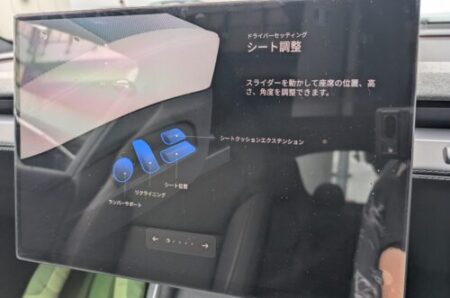
The screen (in Japanese) reads: “Driver Settings — Seat Adjustment. Move the sliders to adjust the seat’s position, height, and angle,” with the controls labeled lumbar support, recline, seat position, and seat cushion extension.
Seats, mirrors, steering wheel — the screen teaches you how to adjust all of it.
In a car with almost no physical buttons, this is where you learn the controls. Makes sense.
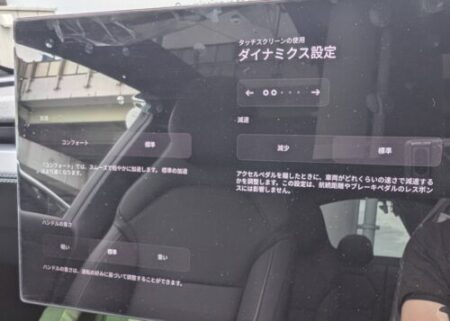
This is the “Dynamics Settings” screen in Japanese: Acceleration (Comfort / Standard), Deceleration (Reduced / Standard — how strongly the car slows when you lift off the accelerator), and Steering Weight (Light / Standard / Heavy).
Being able to tweak acceleration behavior and steering weight from a screen was a novelty for me.
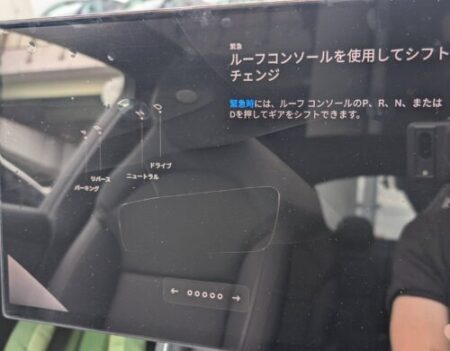
The Japanese text says: “Emergency — Shifting with the roof console. In an emergency, you can shift gears by pressing P, R, N, or D on the roof console.”
There was even an on-screen explanation of how to shift gears from the roof console buttons in an emergency.
All of this runs automatically without taking up any staff time. Ruthlessly rational — I was impressed.
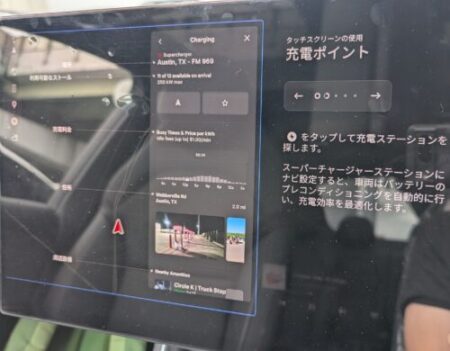
The Japanese instructions read: “Charging Points — Tap the lightning-bolt icon to find charging stations. When you navigate to a Supercharger, the car automatically preconditions the battery to optimize charging.” (Amusingly, the sample listing in the tutorial is a Supercharger in Austin, Texas.)
Charging is tied into the navigation: route to a Supercharger and the car preconditions the battery on the way.
Japanese automakers have only recently started adding this — Tesla has had it forever.
“Delivery Complete” — In the App
Once I’d worked through everything, a completion screen popped up in the Tesla app on my phone.
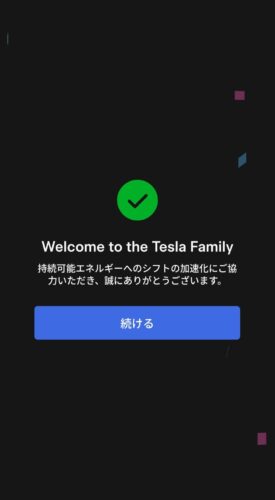
“Welcome to the Tesla Family.”
The Japanese subtitle beneath it says: “Thank you very much for helping accelerate the shift to sustainable energy.”
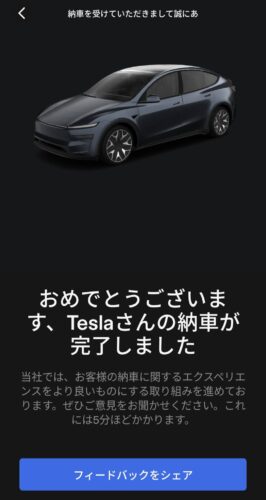
This screen (in Japanese) says: “Congratulations — your Tesla delivery is complete,” followed by a request to share feedback about the delivery experience.
Paperwork in the app, car key on the phone. From start to finish, the entire delivery lived inside a smartphone.
The Drive Home Was the First Drive
Before setting off, I did one lap around the body to check for scratches.
Then the drive home from the store became my first drive in the Model YL.
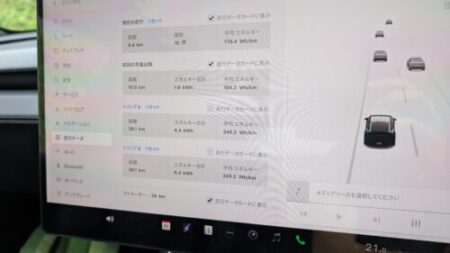
This is the trip data screen with the UI in Japanese, showing distance, total energy, and average consumption in Wh/km for each trip meter. The odometer line at the bottom reads 26 km.
The odometer read just 26 km. Practically a blank slate.
That silent, effortless surge of acceleration is a completely different animal from the diesel I drove for 500,000 km.
I thought the ATTO 3 had gotten me used to EVs, but a car this size gliding off in silence still felt fresh.
I’ll be commuting nearly 200 km a day in it, so I expect to get a feel for real-world efficiency and range very quickly.
Wrapping Up
A month late, but that’s the record of Model YL delivery day.
- Delivered on May 23, 2026
- No ceremony — the handover was astonishingly quick
- Initial setup via on-screen tutorials, paperwork via the app
This blog has mostly been a log of BMW DIY maintenance, but from here on I’ll be writing up my notes on the Model YL the same way.
Since it’s replacing the F25 as my commuter, the mileage is going to pile up fast.
Charging, the practicality of the third row, running costs — I’ll keep documenting the real-world experience as the kilometers accumulate.
Next up: the first-month inspection at the Kyoto Shijo Service Center. Two months on I also added up what the first 10,000 km actually cost to run.

This article is also available in Japanese.