Will there be a free stall when I get there?
Anyone who drives an EV any distance carries that question around. It sits in the back of your head the whole way.
And when you are worried about it, you top up more than you need. Just in case.
But if everybody tops up more than they need, stalls do not free up. Stalls not freeing up is what makes the next person anxious, so they top up more than they need too. That loop, more than anything else, is what Supercharger etiquette is really about at busy sites.
This is the second half of our overnight family trip from Kansai to Karuizawa. The first part covered the hour we spent at Matsumoto. Here is why I filled up so thoroughly there, what the queue at Karuizawa looked like, plus what I think about the percentage you should stop at.
Why Karuizawa Is Always Busy
Open the app, look at Karuizawa, see a wait. That is close to a constant.
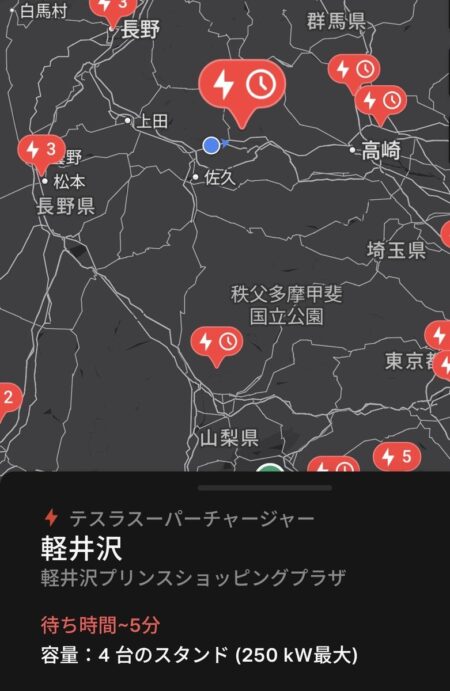
The panel is in Japanese. It reads “Tesla Supercharger Karuizawa / Karuizawa Prince Shopping Plaza / Wait time ~5 min / Capacity: 4 stalls (250 kW max)”.
The reason is simple. It is a resort town with four stalls, which is nowhere near enough for the demand.
On a weekend Teslas arrive in a steady stream, so the site fills almost immediately. When we drove to a mall for dinner during the trip, several cars were queuing.
Not enough stalls creates the fear of not getting charged at the next stop. That fear pushes every driver’s session longer. The loop from the opening, running in the wild.
The Plan: Fill Up at Matsumoto Instead
59 Minutes at Matsumoto, Over Lunch
So the plan was to treat Karuizawa as unavailable, then arrive with plenty in the battery by charging hard at Matsumoto on the way.
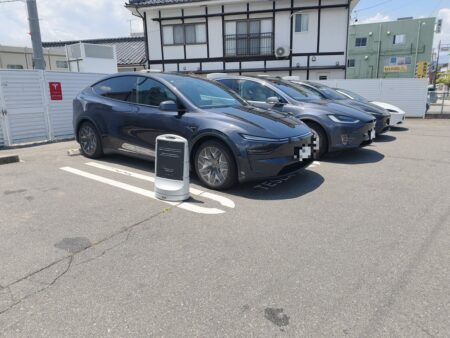
Matsumoto was also full when we arrived, all four stalls busy, but it is nothing like Karuizawa.
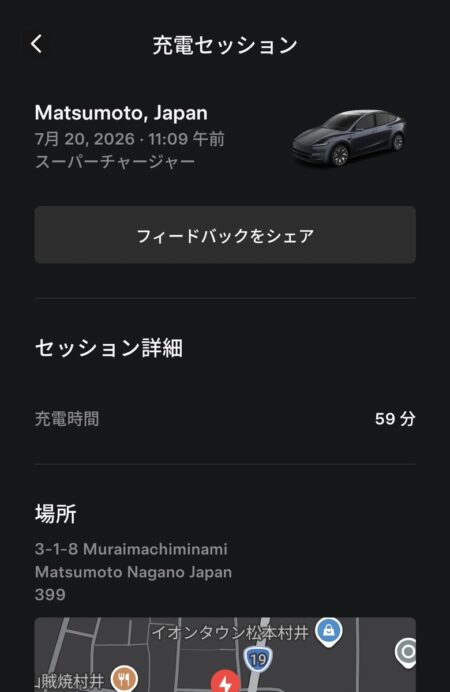
The record is in Japanese: “Charging session / 20 July 2026, 11:09 AM / Supercharger”, then “Session details — Duration: 59 min / Location: Aeon Town Matsumoto Murai”.
Fifty-nine minutes on the clock.
That sounds long written down. It was also exactly the time we spent having lunch with the kids, so nobody experienced it as waiting.
14 Minutes at Karuizawa, Stopped at 80%
The original intention was to not charge at Karuizawa at all.
Then we went further than planned, out towards the Usui Pass, so the reserve for the drive home started looking thin.
I checked the Karuizawa Supercharger, and because this was a weekday there was actually a stall free.
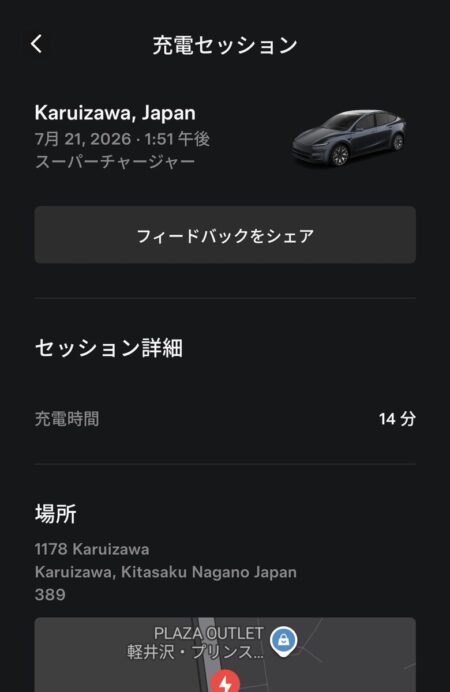
The record reads “Charging session / 21 July 2026, 1:51 PM / Supercharger”, then “Duration: 14 min / Location: Karuizawa Prince…”.
Fourteen minutes. That is all it took, because Matsumoto had done the heavy lifting the day before.
Those fourteen minutes were spent buying souvenirs, so again, no waiting.
I stopped at 80%, which was enough to get home, rather than filling further.
There was a free stall at the time, but this is still a popular site. Keeping the session short felt like the right way to leave it for the next person.
Supercharger Etiquette: What Percentage Should You Unplug At?
This is the question every EV driver on a long trip has to answer.
Charging slows down as the battery fills, so past roughly 80% you are adding very little per minute. If people are waiting, holding out for 90% or more is hard to justify.
My own view is that when a site is full with a queue, Tesla could reasonably step in as the operator: cut sessions above 80%, or price the extra so it costs something.
Drawing the line is genuinely hard, though. What counts as busy? And you cannot force people to do anything.
I also understand the impulse completely. Nobody overfills out of selfishness, they do it because they are not sure about the next stop. The only real cure for that uncertainty is more chargers.
Back Home: 13% to 70% in 23 Minutes
Once we got home I topped up at my local Supercharger.
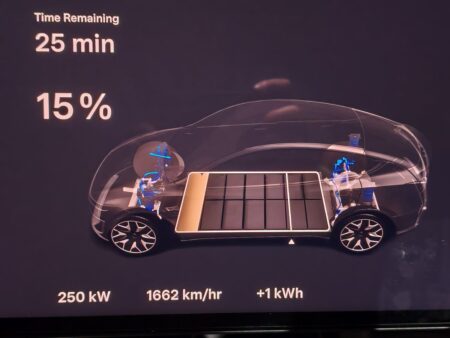
An empty site near home gave a clean 250 kW.
Charging speed really is best at low state of charge, which is something I measured properly in my charging curve post. This time I took it to 70%, roughly two days of commuting.
13% to 70% in 23 minutes. Under half an hour, which is the least stressful way I have found to run this car.
843.8 km Over Two Days
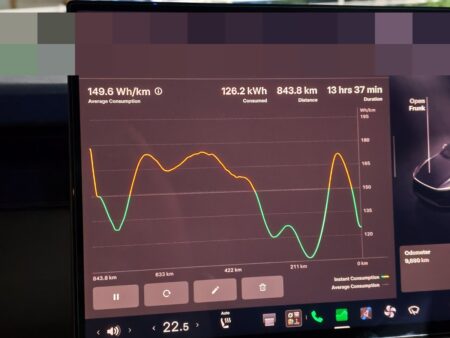
Two days, 843.8 km total.
That is more than the 800 km or so I had planned for. Even so, one solid session at Matsumoto plus a fourteen-minute top-up at Karuizawa carried the whole thing with no queuing at all.
Deciding where you are going to charge, before you leave, matters more than I gave it credit for. At the pace I drive, 10,000 km in two months, that planning gets a lot of use.
Summary
What the Karuizawa half taught me about Supercharger etiquette:
- Karuizawa is a resort town with four stalls, so weekends mean queuing
- The fix was charging hard at Matsumoto first; 59 minutes there disappeared into lunch
- Karuizawa was quiet on a weekday, so I added 14 minutes then stopped at 80%
- When a site is full with people waiting, unplugging at 80% is the better call
- Anxiety drives overfilling. The root fix is more stalls
I could have got away with 70% at Karuizawa if I wanted to cut it fine, but there is no reason to run a family trip that close to the edge.
For now my rule is: if a site ahead looks likely to be busy, fill up before it, then take only what I need there, or skip it entirely. That has kept every trip relaxed so far.
I do keep hoping Tesla expands the resort-town sites.
Three years of free charging is a real gift, so the least I can do is leave the stall free for whoever is next.

This article is also available in Japanese.