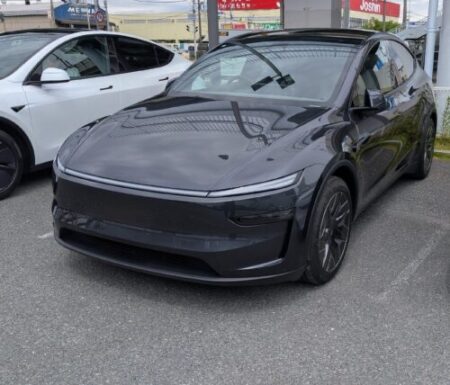
I plugged the Model YL into a 250 kW Supercharger at 13% while running errands, and this time I tried supercharging without preconditioning the battery at all.
Normally I set the charger as a navigation destination so the car warms the pack on the way. This time I set nothing. Ambient temperature was 29°C (84°F), I had not been running on the motorway, and it was dark, so the pack had no reason to be warm.
How much output do you lose with a cold-ish battery? That was the question. Eleven seconds after plugging in, the car was pulling 250 kW.
It ran to 75% in 27 minutes 10 seconds, taking 54 kWh. I shot 64 screenshots along the way, one for every 1% of state of charge, so this time I can also work out where the smart place to unplug actually is.
Supercharging without preconditioning at 13%
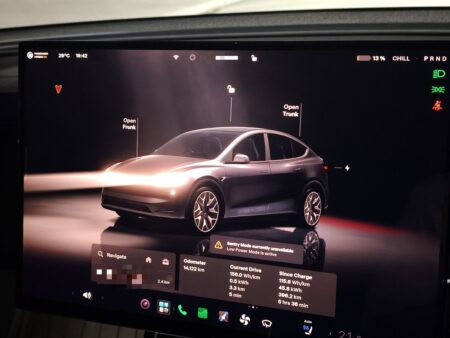
The odometer read 14,122 km (8,775 miles). The leg since the previous charge was 396.2 km on 45.8 kWh, which works out to 115.6 Wh/km (186 Wh/mile). For summer driving with the air conditioning running the whole time, I think that is a decent number.
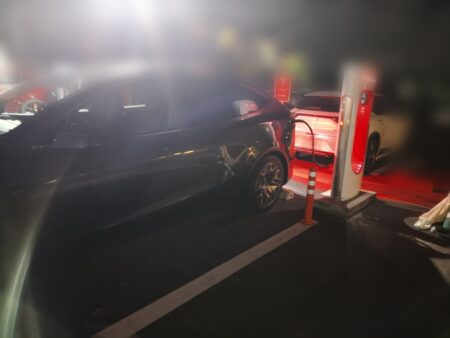
The site is a V3 with 250 kW stalls, part of the Tesla Supercharger network. Two stalls were in use including mine. I walked off to do my shopping as soon as it started, so the climate control was off for the whole session.
The measured curve: 250 kW held to 16%
Below are the Tesla app screenshots, labelled with elapsed time from the start. State of charge on the left, power plus energy added on the right.
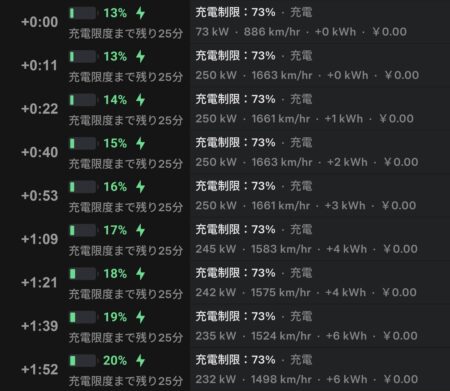
It started at 73 kW, then hit 250 kW eleven seconds later. If that is what a cold pack does in summer, preconditioning may simply not be worth the effort in August.
The 250 kW figure held to 16%. After that: 245 kW at 17%, 242 kW at 18%, 235 kW at 19%, 232 kW at 20%.
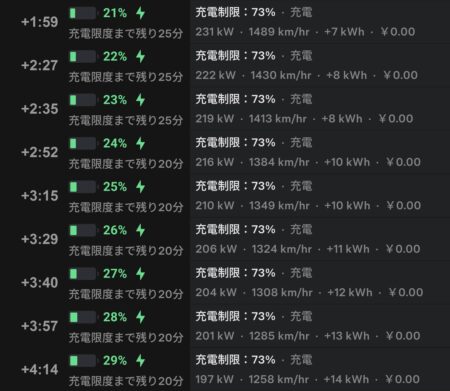
From there it kept shaving off 3 to 9 kW per percent: 231 kW at 21%, 222 kW at 22%, 219 kW at 23%, 216 kW at 24%, 210 kW at 25%. Reaching 25% took 3 minutes 15 seconds.
A short peak, but the gentlest taper I have recorded
This is the fourth session I have logged this way. In terms of holding the peak, it is the weakest of the four: 250 kW to 16% is short of the 18% I saw at Otsu, well short of the 22% I saw in Miyazaki.
The taper, though, was the gentlest of the four. At 25% the Miyazaki session was down to 155 kW, Otsu to 137 kW. This one still had 210 kW.
There were no step changes, just a few kW shaved off per percent. Nothing that looks like heat limiting. My working theory is that plugging in cold left thermal headroom for the whole session. I put the four-session comparison in an earlier charging curve article.
At 47% two more cars arrived
The smooth curve did break once.
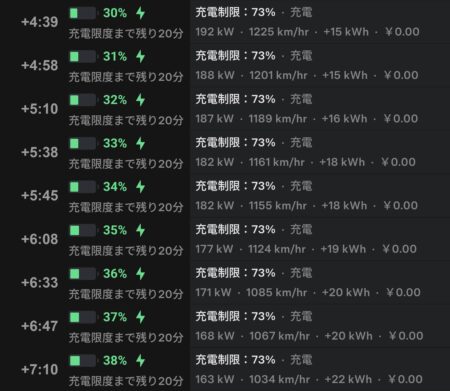
192 kW at 30%, 177 kW at 35%, 163 kW at 38%. Still a clean, even slope.
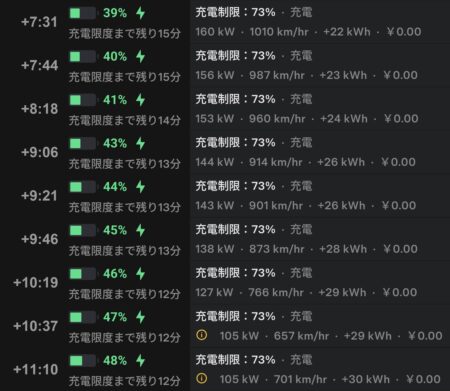
138 kW at 45%, 127 kW at 46%, then 105 kW at 47%. A 22 kW drop in a single percent, four to five times the previous rate.
The screen showed the “charging speed limited by the charging station” notice. On a V3 site two stalls share one power cabinet, so a neighbour costs you output. Two more cars had indeed pulled in after me. The numbers noticed before I did.
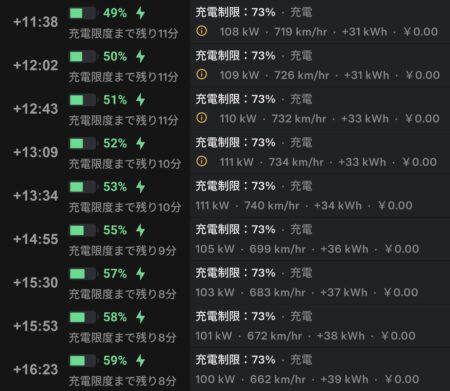
What I liked is that it clawed back: 108 kW at 49%, 109 kW at 50%, 110 kW at 51%, 111 kW at 52%. Rather than sitting at the floor, it picks up whatever capacity frees up. The notice was visible from 47% to 52%, gone by 53%.
27 minutes 10 seconds to 75%
My charge limit was set to 73%. While I was still shopping it looked like the session would finish before I got back, so I raised it to 75% from the app.
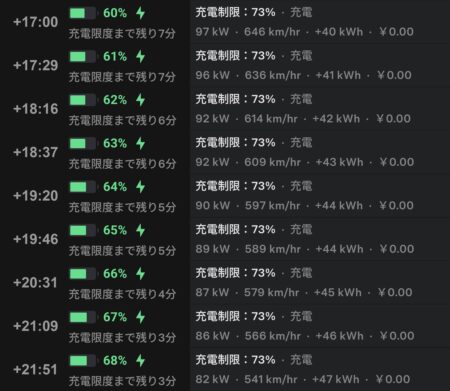
97 kW at 60%, 89 kW at 65%, 82 kW at 68%. By this point each percent takes over 40 seconds.
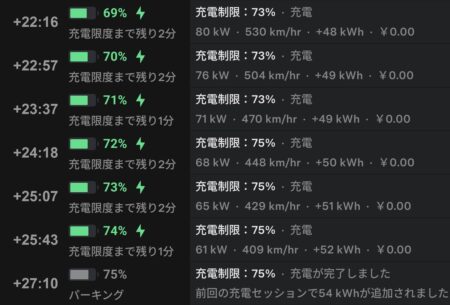
76 kW at 70%, 65 kW at 73%, 61 kW at the final 74%. Done at 27 minutes 10 seconds, 54 kWh added, ¥0.00 to pay. The car came with three years of free Supercharging, so the whole session cost nothing.
Where is the best point to unplug
Instantaneous power is what the screenshots show, but what actually matters on a trip is the average power up to the moment you unplug. So I worked that out for every exit point. The full log has 62 rows, so the table below samples it every 5%.
| State of charge | Added | Elapsed | Power | Energy in | Average so far |
|---|---|---|---|---|---|
| 13% (start) | ±0% | 0:00 | 73 kW | 0 kWh | — |
| 18% | +5% | 1:21 | 242 kW | 4.4 kWh | 194 kW |
| 23% | +10% | 2:35 | 219 kW | 8.7 kWh | 202 kW |
| 28% | +15% | 3:57 | 201 kW | 13.1 kWh | 198 kW |
| 33% | +20% | 5:38 | 182 kW | 17.4 kWh | 186 kW |
| 38% | +25% | 7:10 | 163 kW | 21.8 kWh | 182 kW |
| 43% | +30% | 9:06 | 144 kW | 26.1 kWh | 172 kW |
| 48% | +35% | 11:10 | 105 kW | 30.5 kWh | 164 kW |
| 53% | +40% | 13:34 | 111 kW | 34.8 kWh | 154 kW |
| 58% | +45% | 15:53 | 101 kW | 39.2 kWh | 148 kW |
| 63% | +50% | 18:37 | 92 kW | 43.5 kWh | 140 kW |
| 68% | +55% | 21:51 | 82 kW | 47.9 kWh | 132 kW |
| 73% | +60% | 25:07 | 65 kW | 52.3 kWh | 125 kW |
| 75% (done) | +62% | 27:10 | — | 54.0 kWh | 119 kW |
The dip between 43% to 48% is the shared-cabinet limit, as is the recovery to 111 kW at 53%. The app only reports energy in whole kWh, so I converted at 0.871 kWh per percent (54 kWh spread over 62 points). Elapsed times are screenshot times, so they sit a few seconds off each transition.
The average holds above 180 kW to 40%
The surprise was how flat the average stays. From 18% to 33% it hovers between 185 kW to 200 kW. Within that band it barely matters when you leave, so if you are not in a rush, staying to the low 30s buys extra range for free.
It falls apart after that. The table shows 182 kW at 38%, then 172 kW at 43%. In the raw 1% data, the average drops below 180 kW from 41%. It slips under 150 kW past 53%, reaching 148 kW at 58%, 140 kW at 63%, 119 kW if you sit there to the end.
Splitting the session into two equal 20% chunks makes it obvious:
- 13% to 33%: 17.4 kWh in 5 minutes 38 seconds, 186 kW average
- 53% to 73%: 17.5 kWh in 11 minutes 33 seconds, 91 kW average
Same energy, twice the time. On a road trip I should have unplugged around 33% here. On this particular evening I was shopping anyway, so the waiting cost me nothing, which makes filling to 75% the right call.
What I take from this
- No preconditioning, 29°C ambient, 13% start: 250 kW eleven seconds after plugging in
- The 250 kW peak lasted only to 16%, yet 25% still showed 210 kW, the gentlest taper I have logged
- A neighbouring car cut me to 105 kW at 47%, released by 53%
- 13% to 75% in 27 minutes 10 seconds, 54 kWh added, ¥0.00 to pay
- Average power stays flat to roughly 33%, above 180 kW to 41%
Supercharging without preconditioning may cost a little peak, but it seems to buy a flatter curve afterwards. I will run the same test in winter, when ambient is near 5°C (41°F), to see whether the picture flips. For the opposite case, a pack that had just been worked hard, see the charge at the end of 602 km on one charge.
This article is also available in Japanese.