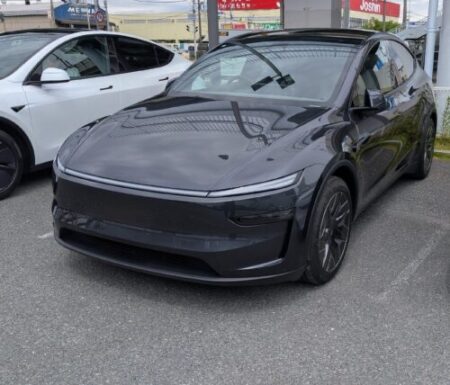
The last day of our Kyushu family trip was the drive home: Kokura to our house near Kyoto, four of us plus four nights of luggage.
I had a plan I wanted to test. Leaving the motorway to charge costs money in Japan, because tolls are charged per entry, so every detour adds to the bill. Instead I would fill to 100% at the Kitakyushu Supercharger, then cover 602 km on one charge without leaving the motorway at all. Passing the exit after midnight would also earn the late-night toll discount.
The distance was about 605 km (376 miles). At around 140 Wh/km the Model YL should manage 610 km. It looked comfortable. The car disagreed, loudly, for the first two hours.
Charging to 100% at Kitakyushu
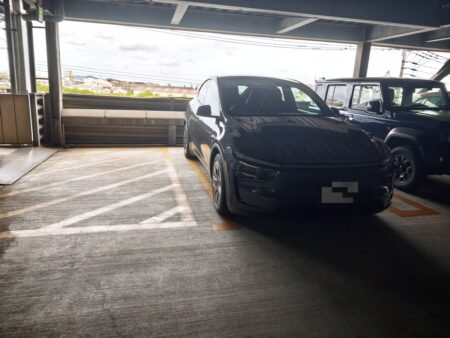
We spent the day in Kokura, then left in the evening so the air conditioning would have less work to do after dark.
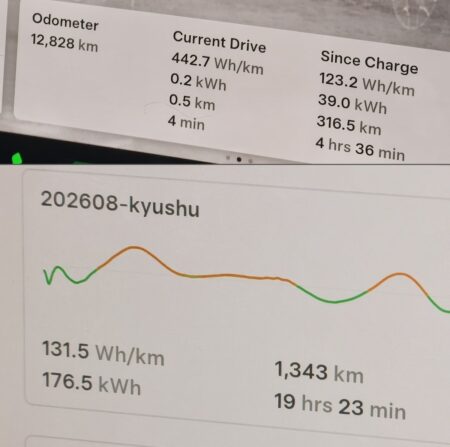
The odometer read 12,828 km. The previous leg from Miyazaki had run at 123.2 Wh/km, with the whole trip sitting at 1,343 km so far.
On the way out we had covered 523.0 km from home to the Yamaguchi Supercharger on a single charge at 134.5 Wh/km, arriving with 7%. Today’s run was 80 km longer, which on paper does not work. But the outbound leg was in afternoon heat at whatever speed I felt like. Tonight I had cooler air, plus the option to back off a little. My two-month average was 127 Wh/km, so that was the number to aim for.
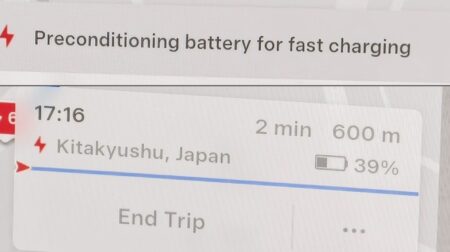
At 17:14 the pack started preheating, 600 m out, at 39%.
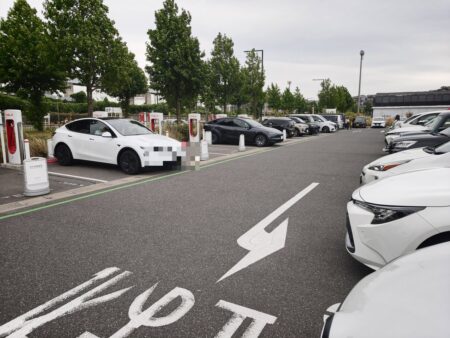
Six stalls, one of them occupied, even though the outlet mall car park next door was full.
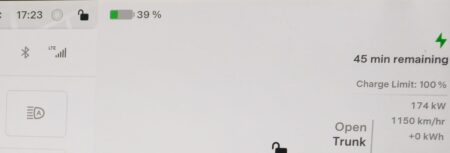
Plugged in at 17:23 at 39%, showing 174 kW. That was the peak for the day, which is what you get for arriving with a fairly full battery.
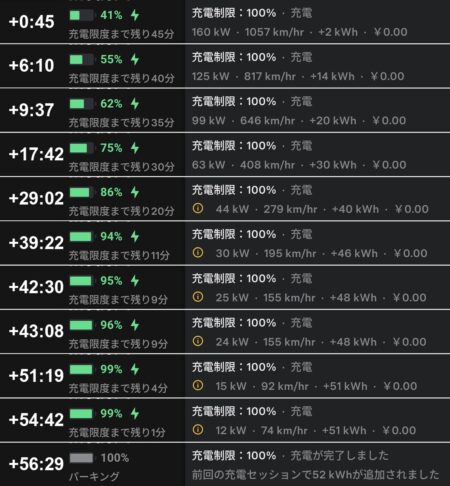
The app log tells the story: 160 kW at 41%, 99 kW at 62% after 9 minutes 37 seconds, 63 kW at 75%, down to 44 kW by 86%. The first 29 minutes bought 47 percentage points. The last 14 points took another 27 minutes.
Finished at 18:19 with 52 kWh added, ¥0 to pay under the three years of free Supercharging that came with the car. Total time 56 minutes 29 seconds.
Setting off to a minus 13% prediction
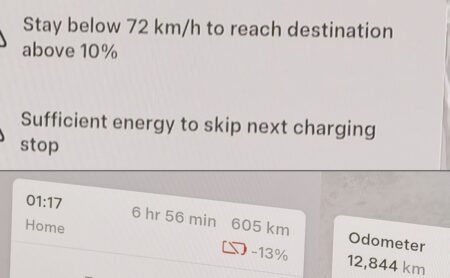
18:21, full battery, 605 km to go, arrival predicted for 01:17. Predicted state of charge on arrival: minus 13%.
Being shown a negative number straight after a full charge is quite something. The car also suggested holding 72 km/h (45 mph) to arrive above 10%, which is not a realistic motorway speed.
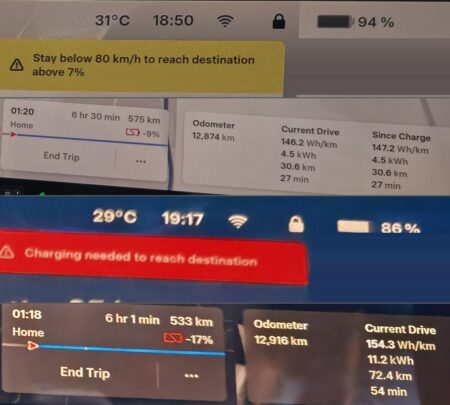
Over the Kanmon Bridge onto the Chugoku Expressway the hills start. At 18:50 the leg was running 146.2 Wh/km with arrival at minus 9%, the advice now 80 km/h. By 19:17 it read minus 17%, in red: “Charging needed to reach destination”, with the leg at 154.3 Wh/km.
I was sitting behind lorries at that point, going with the flow, still being told it was not enough. This was the low point of the drive. I was fairly sure the plan had failed.
Two hours in, the numbers turned positive
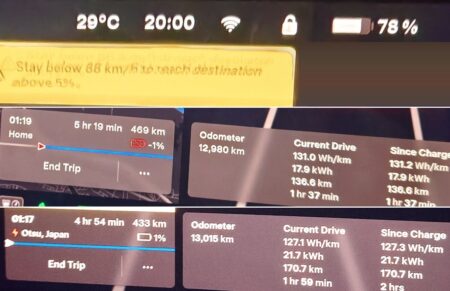
At 20:00 the prediction had recovered to minus 1%, the leg down to 131.0 Wh/km. Flat ground on the Sanyo Expressway did that, a 16 point swing in under an hour.
By 20:23 the destination had switched to the Otsu Supercharger, 433 km away, at plus 1%.
We stopped once at a service area to get the kids brushed, then folded the rear seats into sleeping mode. Back on the road at 21:03 at plus 2%. From there I stopped nursing it and ran with the traffic. The prediction wandered between minus 1% to plus 2% for the rest of the night, never collapsing again. That service area to Otsu was four hours non-stop.
602 km on one charge, arriving with 1.7% left
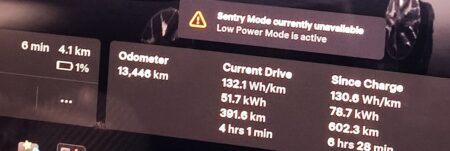
01:03 at the Otsu Supercharger. The leg came in at 602.3 km, 130.6 Wh/km, 78.7 kWh used, 6 hours 28 minutes. The screen was showing Low Power Mode, with Sentry Mode unavailable. That is what 1% looks like.
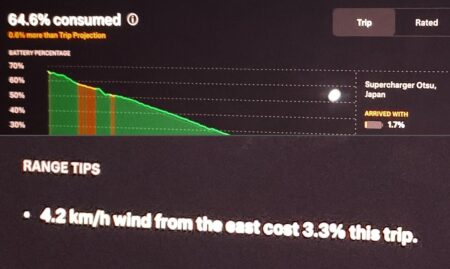
The Energy screen logged 1.7% on arrival, 0.6 points worse than predicted. It also blamed a 4.2 km/h easterly wind for 3.3% of the trip. A walking-pace headwind sounds trivial until you stack it up over 600 km.
Recalculating afterwards, my estimate had been optimistic. The 78.7 kWh figure covers driving; climate control sits on top of it. Had the car really run at the 140 Wh/km I assumed, I would have run dry short of 600 km. The navigation was right to open with minus 13%, and backing off after that warning is what got us home.
The midnight toll discount
We passed the exit at about 00:58. The toll came to ¥8,660 (approx. $58) instead of ¥12,800 (approx. $85), a saving of ¥4,140. Leaving the motorway to charge would have lost that discount, then added a fresh entry charge on top. The no-charging plan paid off more in tolls than in electricity.
251 kW from 1.7%
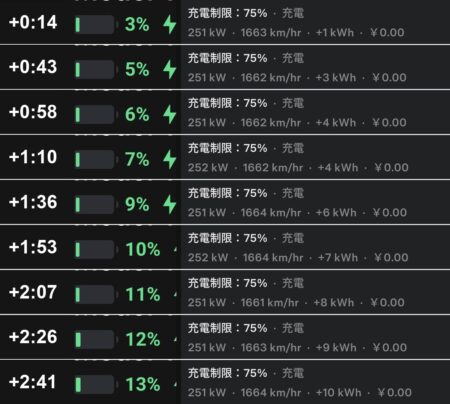
Arriving at 1.7% means the display starts at 2%. My first screenshot, 14 seconds in at 3%, already showed 251 kW.
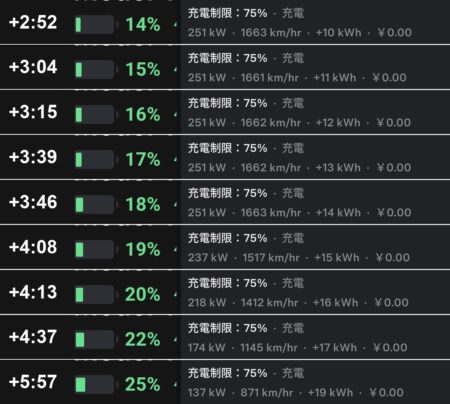
Each percent took about 15 seconds. It was late, so I unplugged at 25%, 5 minutes 57 seconds after plugging in. Emptying the battery first really does make the first few minutes fly. The full 1% by 1% log went into my Supercharger charging curve article, part of the wider Tesla Supercharger network.
What the day proved

The whole Kyushu trip came to 1,964 km at 132.0 Wh/km.
- 602.3 km on one charge at 130.6 Wh/km in 6 hours 28 minutes, arriving with 1.7%, carrying four people plus luggage, at night, with the air conditioning on
- The arrival prediction opened at minus 13%, sank to minus 17%, recovered to minus 1% within 43 minutes of reaching flat ground
- The midnight discount cut the toll from ¥12,800 to ¥8,660
Arriving with 1.7% means I left a little on the table. A slightly higher cruising speed would have shaved a few minutes off the drive. Still, getting home without stopping felt good, so the next 600 km run starts from the same plan. For efficiency numbers over a longer period, I wrote up two months, 10,000 km in the Model YL.
This article is also available in Japanese.