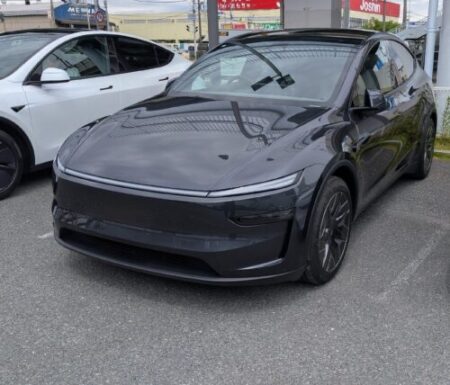
My Tesla Model YL reached 20,000 km on 17 September 2026, just 117 days after delivery on 23 May. It seemed a good time to check Model YL efficiency again, plus what all that driving had cost.
During my commute, I spotted 19,999 km on the display. Just as at the 10,000 km milestone, I caught the number rolling over.
Three years of free Supercharging have kept my energy bill tiny. This time I compared it with both diesels I drove before the Tesla: my BMW G05 X5 plus my F25 X3.
20,000 km in 117 Days
Here is the change from 19,999 km to 20,000 km.
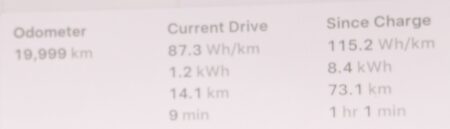
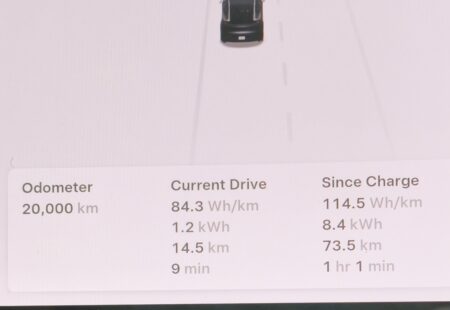
The Tesla app showed the milestone too.
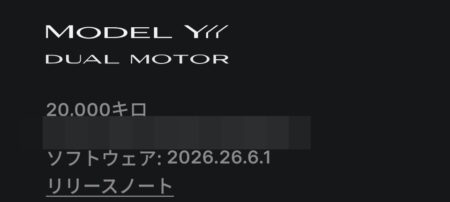
The Japanese app screen shows 20,000 km, software version 2026.26.6.1, plus a link to the release notes.
Around 5,200 km a Month
That works out to roughly 171 km a day: about 5,200 km a month, equivalent to 62,000 km a year at the same pace.
The first 10,000 km took 61 days. The next 10,000 took 56 days, helped along by our Kyushu trip plus a drive to Gifu.
My 10,000 km efficiency report has the earlier figures.
At this rate I would reach the basic warranty’s 80,000 km limit around September 2027, roughly 15 to 16 months after delivery.
Model YL Efficiency: 126.1 Wh/km
I have not reset Trip B since delivery, so it keeps the running total.
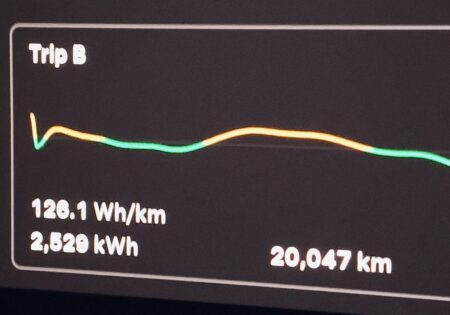
At 20,047 km, it showed 2,529 kWh consumed with an average of 126.1 Wh/km. That is about 7.9 km/kWh.
My previous Model YL efficiency report ended at 127.1 Wh/km, so the overall result has barely moved.
Commuting Helps; Motorway Trips Push It Up
The lifetime average keeps hovering around 125 to 130 Wh/km. Commuting brings consumption down, then a motorway trip at higher speeds pushes it back up.
Winter will bring heating plus battery temperature management. I am curious how much that changes the figures.
2,980 kWh Charged, 98% From Superchargers
The Tesla app’s Charging Stats show the other side of Model YL efficiency: energy charged rather than energy recorded by Trip B.
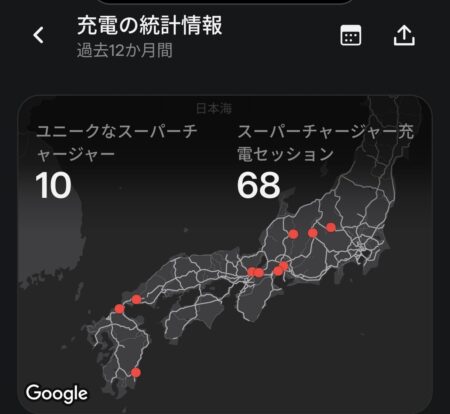
The Japanese screen lists 10 unique Superchargers plus 68 Supercharger charging sessions over the past 12 months.
The red dots on the map reach all the way to Kyushu.
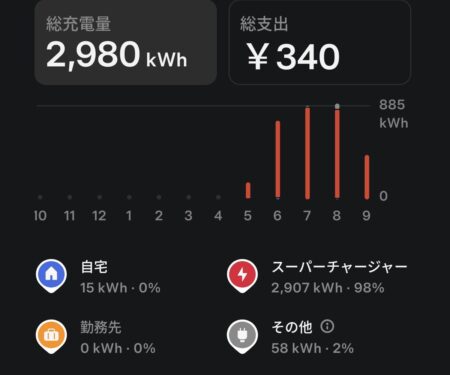
The Japanese screen shows 2,980 kWh charged, total spend ¥340 (approx. US$2.27), home 15 kWh, work 0 kWh, Superchargers 2,907 kWh (98%), other chargers 58 kWh (2%). USD equivalents here use an illustrative ¥150 per US$1, matching the approximate conversions in my earlier report.
Superchargers supplied 2,907 kWh: 98% of the total. The other 58 kWh included hotel Destination Charging on our Kyushu trip.
Compared with Trip B’s 2,529 kWh, roughly 85% of charged energy went into driving. The remaining 15% covers charging losses plus other consumption, such as climate control while parked. That is almost the same proportion as at 10,000 km.
Energy Costs Compared With My BMW Diesels
I used my actual fuel economy in the X5 plus X3 to estimate their fuel bills over 20,000 km. A petrol car returning 20 km/L is included as another reference.
The Japanese Agency for Natural Resources and Energy fuel-price survey gave national averages of ¥159.3/L for diesel (approx. US$1.06) plus ¥169.9/L for regular petrol (approx. US$1.13) on 14 September 2026. I rounded those to ¥159/L plus ¥170/L for the calculations.
For electricity, I used the full 2,980 kWh charged, rather than just the energy shown by Trip B.
| Scenario | Consumption / price | Cost over 20,000 km | Approx. annual cost at this driving pace |
|---|---|---|---|
| BMW G05 X5 diesel | 15 km/L; ¥159/L | ¥212,000 (US$1,413) | ¥661,000 (US$4,407) |
| BMW F25 X3 diesel | 17 km/L; ¥159/L | ¥187,059 (US$1,247) | ¥584,000 (US$3,893) |
| Petrol car, reference | 20 km/L; ¥170/L | ¥170,000 (US$1,133) | ¥530,000 (US$3,533) |
| Home charging, estimate | ¥20/kWh; 2,980 kWh | ¥59,600 (US$397) | ¥186,000 (US$1,240) |
| My actual charging | Three years of free Supercharging | ¥340 (US$2.27) | Almost zero |
All USD figures are approximate. Annual estimates use the 117-day driving pace before rounding it to about 62,000 km per year. The assumed home electricity rate of ¥20/kWh is roughly US$0.13/kWh.
The X5 would have used ¥212,000 of diesel, while even the X3 would have needed ¥187,059. I thought both were inexpensive to run at the time.
Against those figures, my Tesla’s energy bill is on another level.
The App Shows Only ¥340 for Home Charging
My Model YL came with three years of free Supercharging as a purchase bonus.
The ¥340 total is the app’s calculation for 15 kWh of home charging, using the home electricity price I entered. It is not a separate meter reading of my electricity bill.
I have plugged in at home occasionally, including after arriving with 4% remaining, or for a small top-up before a trip.
Compared with the diesel estimates, that leaves roughly ¥212,000 saved against the X5. Against the X3, the saving over these 20,000 km is about ¥187,000.
Even Home Charging Would Be About ¥60,000
For life after the free period, I also calculated what home charging would cost.
At an assumed overnight rate of ¥20/kWh, 2,980 kWh comes to ¥59,600. That is less than a third of the X5’s diesel estimate.
The free charging bonus makes the biggest difference today, but Model YL efficiency still gives me a much lower energy cost in this home-charging scenario.
Three Years Could Save Over ¥1.75 Million in Diesel
Keeping this pace for three years, roughly 62,000 km annually, would bring the total to about 187,000 km.
The X5’s estimated diesel bill would be around ¥1.98 million (approx. US$13,200). The X3’s would still be around ¥1.75 million (approx. US$11,667). With the free Supercharging bonus, I would avoid almost all of that, apart from occasional paid home charging.
The Model YL felt expensive to buy, but this is one place where I can see the running costs making up ground.
Where Things Stand at 20,000 km
- 20,000 km in 117 days: roughly 5,200 km per month.
- Average Model YL efficiency of 126.1 Wh/km, about 7.9 km/kWh.
- Trip B records 2,529 kWh used at 20,047 km.
- Total charged: 2,980 kWh, with 98% from Superchargers.
- Estimated diesel cost: ¥212,000 for the X5; ¥187,059 for the X3.
- Hypothetical home charging at ¥20/kWh: ¥59,600.
- Actual charging cost shown in the app: ¥340.
Both BMWs were economical diesels, but this has been much cheaper. While free Supercharging lasts, I intend to keep enjoying the car at this pace.
If winter brings a noticeable change in consumption, I plan to write about it.

This article is also available in Japanese.