The ATTO 3 12V battery is the part of this car I never expected to worry about. It is an EV. The interesting battery is supposed to be the big one under the floor.
Then the dealer handed back the inspection sheet in May, pointed at the little lead-acid unit in the engine bay, plus suggested I start thinking about replacing it.
We may swap this car for something else in about a year, once the subsidy holding period ends. Buying a new battery now felt like money thrown away, so I tried the pulse charger sitting in my garage instead.
The ATTO 3 12V battery flagged at the 24-month inspection
I put the ATTO 3 through the Japanese vehicle inspection myself back in February, which covers the test lane but not the statutory 24-month service. That part went to the dealer in May, at 26,758 km. The car was first registered in March 2023, so it had just passed three years.
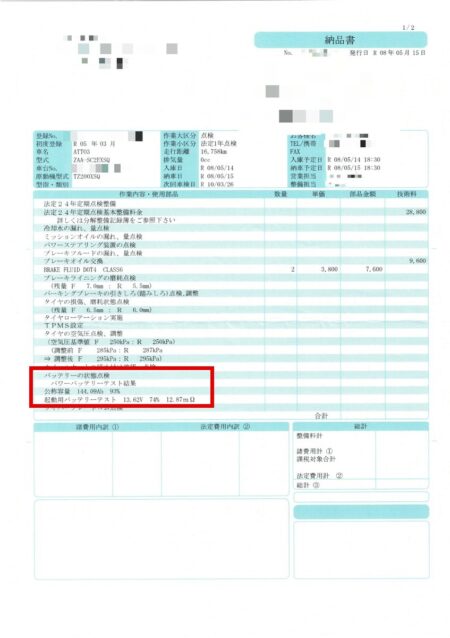
The invoice is in Japanese. The red box marks the battery condition section.
What the test numbers say
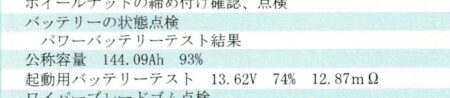
Translated, the rows read: “Battery condition check / Power battery test result / Nominal capacity 144.09 Ah, 93% / Starter battery test 13.62 V, 74%, 12.87 mΩ”.
Voltage is fine. For the ATTO 3 12V battery, internal resistance is the number that matters, because a high figure means the battery cannot deliver current when something actually asks for it. That 74% state of health is another way of saying the same thing.
The traction pack is the healthy one
The 144.09 Ah traction pack came back at 93%.
That pack was replaced whole in February 2024, during the first year of ownership, after cell 53 of 122 sagged to around 1.5 V. More than two years later it still calibrates cleanly from the low teens up to 100%.
So the part I was told to worry about is the old-fashioned lead-acid one. In an electric car. There is something quietly funny about that.
Why the ATTO 3 12V battery is a weak point
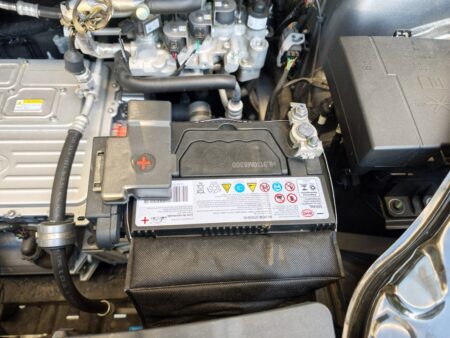
It is a 38B20L, the same ordinary size you find in a small petrol hatchback.
This is where the ATTO 3 is unusual. From the Dolphin onwards, BYD moved the 12V supply to LFP lithium chemistry, relocating it under a seat. Among BYD cars sold in Japan, one carrying lead in the engine bay is now the minority case.
It matters more than it sounds. An EV has no alternator topping the 12V up whenever the motor turns. A DC-DC converter handles it, but only when the car decides to. Depending on how you use the car, the 12V can sit chronically undercharged.
Owner forums carry reports of ATTO 3s that would not start at two years old, around 25,600 km, with a flat 12V.
Mine has not stranded me. Having been told the ATTO 3 12V battery is losing ground, though, ignoring it seemed unwise.
The LVYUAN pulse charger
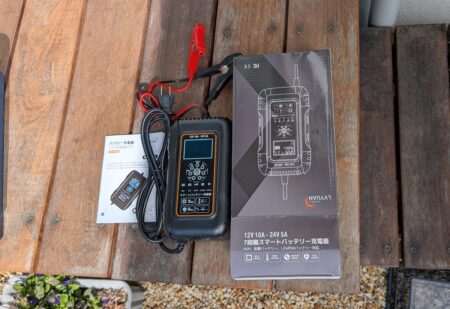
This is an LVYUAN BC1D, bought in February for ¥3,399 (roughly $23). Points brought the actual payment down to ¥2,930, about $20.
It does 10 A at 12 V, 5 A at 24 V, across seven automatic stages. It handles flooded lead-acid, AGM, GEL, even LiFePO4. Getting a desulphation pulse mode at that price is the part I like.
The ATTO 3 was not its first job. I bought it when the alternator on our BMW X3 died, so it has already spent a long weekend keeping that car alive.
Similar chargers with a repair mode turn up on AliExpress too. The 12V-only versions push 15 A rather than 10 A, with Winter, Summer, plus Repair modes. Mine is the LVYUAN, but if you never need 24 V those look like reasonable alternatives.
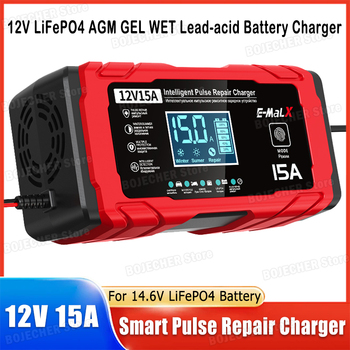
Overnight pulse charging with the battery in place
I started on the evening of 25 July, deliberately picking the night before a day off. This job takes over the car until morning.
Getting mains power out to the car
The charger lead did not come close to reaching a socket from where the car parks. I used a 10 m weatherproof extension reel rated to 1500 W. Leaving something plugged in outdoors all night is much easier on the nerves when the reel is rated for rain.
Clips on, terminals left connected
Disconnecting the terminals on a modern car risks losing stored settings, so the battery stayed bolted in with both terminals attached. The crocodile clips just go on top.
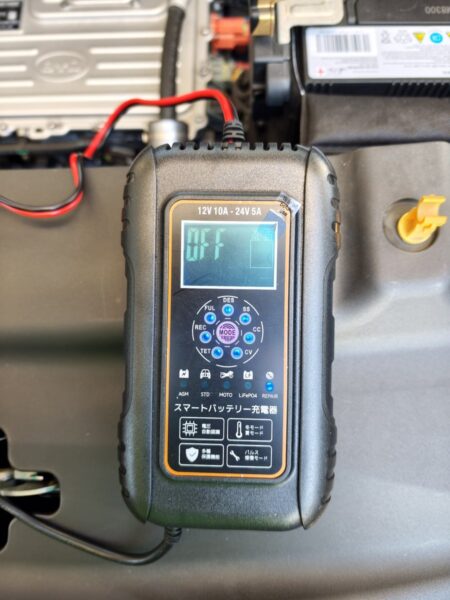
The screen shows OFF. The lit REPAIR label along the bottom row is the desulphation mode.
Lead-acid plates grow lead sulphate crystals over years of partial cycling. That build-up is what drives internal resistance up. Pulse charging throws high-frequency current at those crystals to break them down. Pushing 12.87 mΩ back down was the whole point of the exercise.
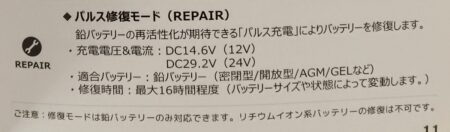
The Japanese manual page explains the REPAIR mode: charging at DC 14.6 V for 12 V batteries, DC 29.2 V for 24 V. Suitable for lead-acid only, including sealed, flooded, AGM, GEL. Repair time up to roughly 16 hours. It warns that lithium-ion batteries cannot be repaired in this mode.
Which is the irony again. The repair mode only exists for lead-acid, so the ATTO 3 having an old-fashioned battery is exactly why this was possible.
From PUL to End, sixteen hours later
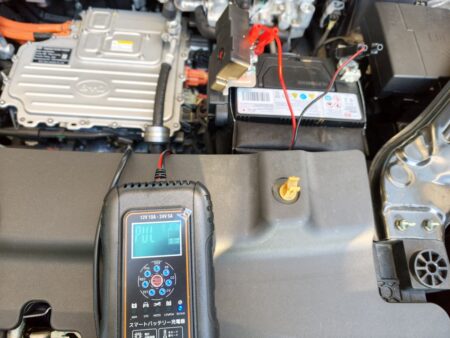
The display switched to PUL once it started.
Then nothing happens for a very long time. The charger cycles between pulsing, then resting, over and over. I started just after 18:00.
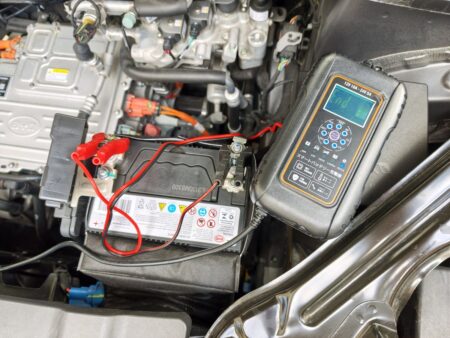
By morning it read End. Around 16 hours in total, which uses up the manual’s stated maximum almost exactly.
Did it work? Honestly, I cannot prove it
Here is the embarrassing part. I never put a tester on it.
No before reading, no after reading. I have no idea what happened to that 12.87 mΩ. The ATTO 3 12V battery cranks the car exactly as it always did. All I can truthfully say is that I believe the internal resistance came down, which is not evidence.
Next time I measure first.
Even so, a ¥3,000 charger plus one night of doing nothing might buy months of postponement. Against the cost of a new 38B20L fitted at a dealer, there was almost nothing to lose.
Wrapping up
- The 24-month inspection at 26,758 km rated the starter battery 13.62 V, 74% health, 12.87 mΩ
- The traction pack, replaced in February 2024, still reads 93%
- BYD models from the Dolphin onwards use LFP lithium for the 12V supply, leaving lead-acid as the minority case
- Owners have reported flat 12V batteries at around two years old
- The LVYUAN BC1D repair mode ran roughly 16 hours with the ATTO 3 12V battery still bolted in the car
- Measuring the result properly is homework for next time
We have about a year left with this car. Whether the lead-acid unit lasts that long depends on the next six months. I will pick this up again at the next inspection, or the first cold morning that changes its behaviour, with a tester in hand.
This article is also available in Japanese.