When my BMW X3 (F25) stopped charging its own battery, I had it towed home before I really knew what was wrong. The first thing I reached for was a BMW X3 battery charger, except I did not own one.
What I did own was a tiny charger for my motorcycle. It worked, eventually, but it took more than two days.
That was enough to convince me to buy a proper BMW X3 battery charger. I ordered one on 28 February 2026, it arrived on 1 March, and this is what happened when I plugged it in.
The motorcycle charger only pushed 750mA
On the day the car came home, I connected the SUPER NATTO motorcycle charger I already had in the garage. Pure first aid.
That unit puts out 750mA. Against a car battery that had dropped to 11.5V, it is an absurdly thin trickle.
I left it connected overnight, came back in the morning, and it still had not finished. Slow charging is gentle charging, so nothing was harmed. It simply took forever.
The LVYUAN BC1D pushes 10A on 12V
So I ordered something built for a car: the LVYUAN BC1D.
It handles 10A at 12V, 5A at 24V. Seven-stage fully automatic, supporting flooded lead acid, AGM, GEL, even LiFePO4. The list price was ¥3,399 (approx. $23 USD). After applying shop points I paid ¥2,930 (approx. $20 USD).
From 750mA to 10A. That is roughly thirteen times the current.
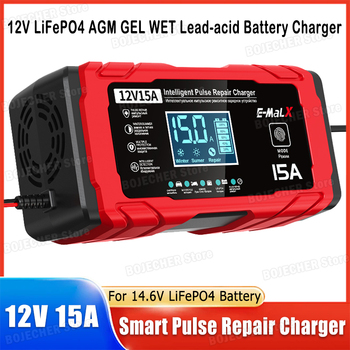
This is a Japanese-market unit, so that exact model is hard to get elsewhere. AliExpress carries the same style of charger with a pulse repair mode: 12V only rather than 12V/24V, but 15A instead of 10A, covering flooded lead acid, AGM, GEL, LiFePO4, with Winter / Summer / Repair modes. Mine is the LVYUAN, so I cannot vouch for this one from experience — if you do not need 24V, it looks like the closest equivalent.
There are plenty of other seven-stage smart chargers to compare against, too, along with whatever your local battery specialist stocks.
Connecting to the terminal under the bonnet
The battery lives under the boot floor. The terminal does not.
On a BMW, the battery sits under the boot floor. That is the annoying part of the F25 layout, because the thought of emptying the boot every time I want to charge is depressing.
It turns out you never need to. The positive charging terminal is routed forward into the engine bay.
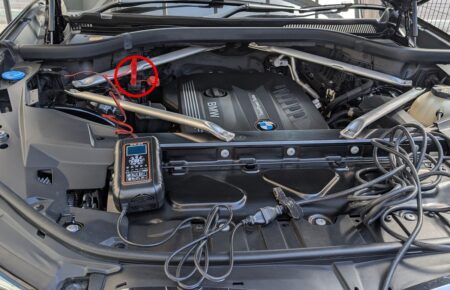
The red circle marks that terminal. Flip open the red cap, clamp the positive lead on, done. I dropped the negative onto a bracket at the far left of the photo.
Because the battery is never removed nor disconnected, none of the car’s stored settings get lost. On a BMW this is the correct way to charge: from the engine bay, never straight onto the battery in the boot.
The car appears to monitor current in plus out at the battery, so charging it directly bypasses that measurement, which stops the car from managing charge properly.
The battery itself is a VARTA AGM that I fitted myself back in March 2021. My dealer quoted ¥89,000 (approx. $600 USD) for the job. Buying online, it cost me about ¥25,000 (approx. $170 USD) all in.
One battery lasted exactly as long as I hoped it would, so I still think that was the right call. VARTA publishes the AGM spec sheets if you want to confirm the fitment before you order.
Choosing AGM mode, starting from “dES”
I selected AGM on the charger. With a VARTA AGM in the car there was nothing to agonise over.
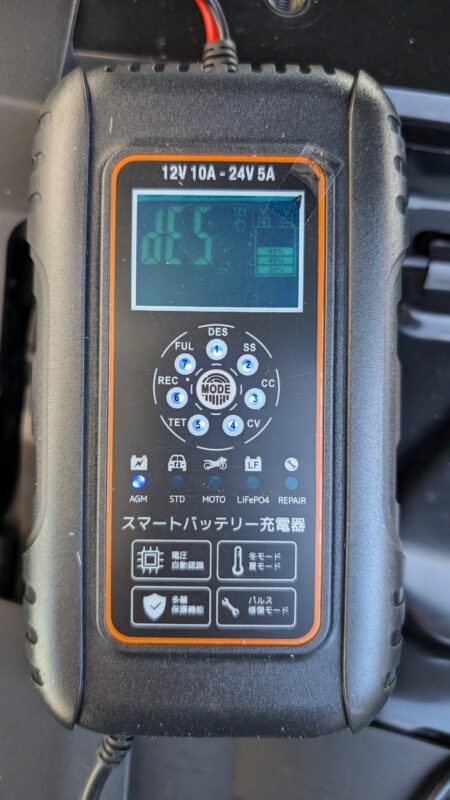
The charger body is labelled in Japanese. The large text reads “smart battery charger”, with the small icons underneath marked “safety protection”, “repair mode”, “pulse charging”.
The display came up with “dES”. That is stage one of seven: desulphation.
Rather than dumping a big current straight in, it first works on breaking down the lead sulphate that has built up on the plates. Treating a deeply discharged battery gently, in the right order, is the whole point of a charger like this.
Twelve minutes in: 18°C, 1.9A, 12.6V
A button on the charger cycles the display. About twelve minutes after starting, I photographed each reading in turn.
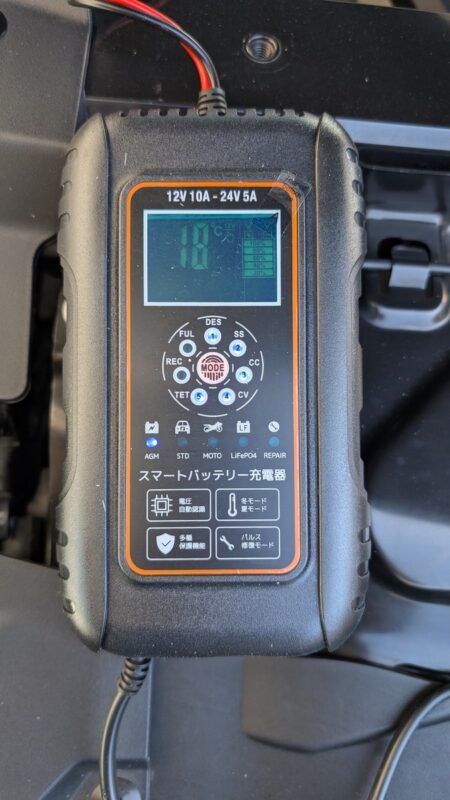
Temperature first: 18°C. Warmer than I expected for a garage at lunchtime on 1 March.
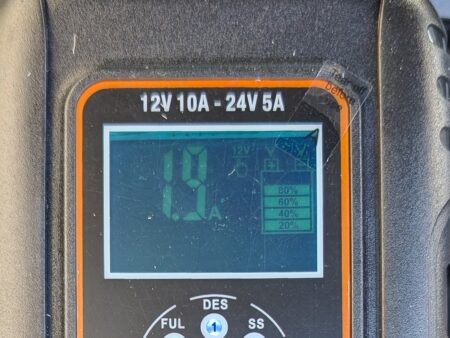
Current: 1.9A. The unit can push 10A, but this is still the desulphation stage so it stays modest. Even so, that is more than double what the motorcycle charger managed.
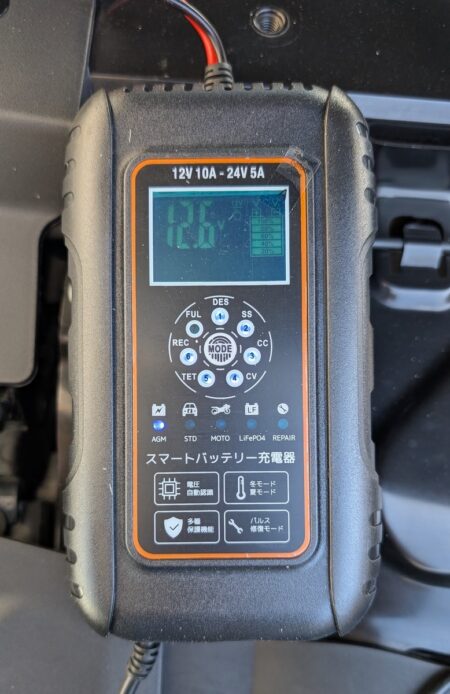
Voltage: 12.6V. It read 11.5V when the car arrived home, so on paper it has recovered nicely.
Bear in mind this is a reading taken while charging, which is not the same as a rested open-circuit voltage.
The whole cycle finished about three hours later. Nothing felt different, no dramatic change in cranking, but the voltage shown before the next start-up was higher. That alone took a lot of weight off my mind.
The charging fault on this X3 turned out to be a failed alternator. I sourced the part from AliExpress later on to replace it myself.
The BMW X3 battery charger keeps earning its place
It was a purchase under ¥3,000, yet it has had a far longer working life than I expected.
After the X3 was fixed, I put a pulse charge through my G05 X5 in May 2026 before sending it off to be sold. If the battery had gone flat right before the appraisal I would never have forgiven myself. Cheap insurance.
Then in July, my ATTO 3 came back from an inspection with a note about the internal resistance of its 12V battery, so that one got an overnight session too.
EVs carry a 12V battery as well, so I expect to keep using this thing for years.
One charger covers every car in the driveway. More to the point, having the tool on hand changes how far you are willing to run a battery down before you replace it.
If you do flatten one at home, you can revive it yourself instead of calling someone out.
Summary
That is the story of the BMW X3 battery charger I bought after the car came home on a truck.
- The emergency motorcycle charger managed 750mA. The 10A unit is thirteen times that.
- The LVYUAN BC1D cost ¥2,930 (approx. $20 USD). Seven-stage automatic, covering AGM, GEL, LiFePO4.
- On an F25 the battery may live under the boot floor, but the charging terminal is up in the engine bay. No need to lift the boot boards.
- Twelve minutes in: 18°C, 1.9A, 12.6V, up from the 11.5V it showed on arrival. Discount it slightly, since it was measured under charge.
- It has stayed busy since: the X5 before its sale, the ATTO 3 for 12V life extension.
You will not feel a difference in how the car drives. But maximising battery life plus the reassurance of being able to charge at home, for this money, is hard to argue with.
I will write it up again the next time it gets pressed into service. That came sooner than I thought: the same charger spent a night on the weak 12V battery in our ATTO 3.
The F25 has had plenty of DIY thrown at it over the years. The engine air filter swap at 244,000 km is another one that takes minutes at home.
This article is also available in Japanese.