On October 21, 2026, Japan’s Ministry of Economy, Trade and Industry (METI) announced a cut to the CEV subsidy, the main Japan EV subsidy for car buyers. The lower amounts apply to new cars registered on or after January 1, 2027.
Specifically, for regular-size EVs, every model drops to roughly 60% of today’s Japan EV subsidy.
We received this subsidy ourselves when buying our EVs, so this news hits close to home. I checked METI’s announcement and the official per-model subsidy list, and put together what changes for anyone thinking about an EV in Japan.
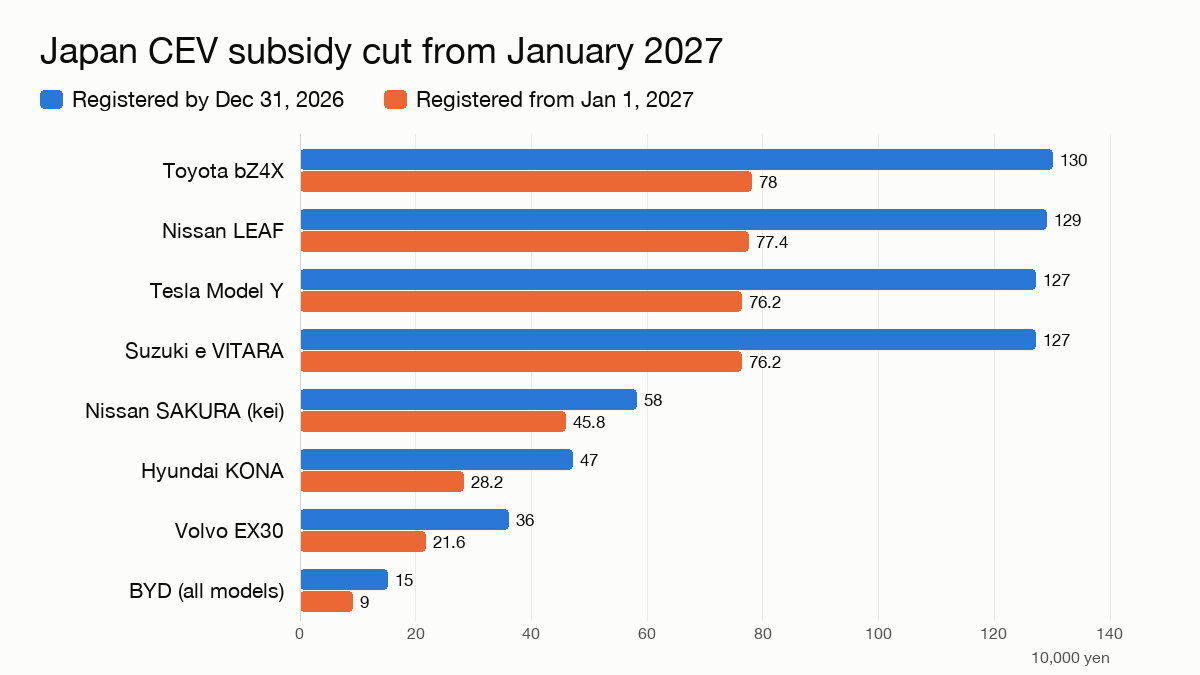
Yen amounts in this article are converted at roughly ¥150 to the US dollar.
What changes with the Japan EV subsidy cut
Here are the key points of METI’s announcement.
- Who it affects: cars registered as new on or after January 1, 2027
- Why: applications are running so high that the budget is expected to run out before the final application deadline of February 12, 2027. METI is lowering the amounts so the subsidy lasts as long as possible within the budget
- This year’s application window is expected to close sometime from early to late December (as of October 9)
The subsidy cap drops to 60%
The CEV subsidy scores each car on its performance and on the carmaker’s efforts (charging network, after-sales support, and so on), and that score sets the cap. METI’s document lists the caps before and after the cut side by side.
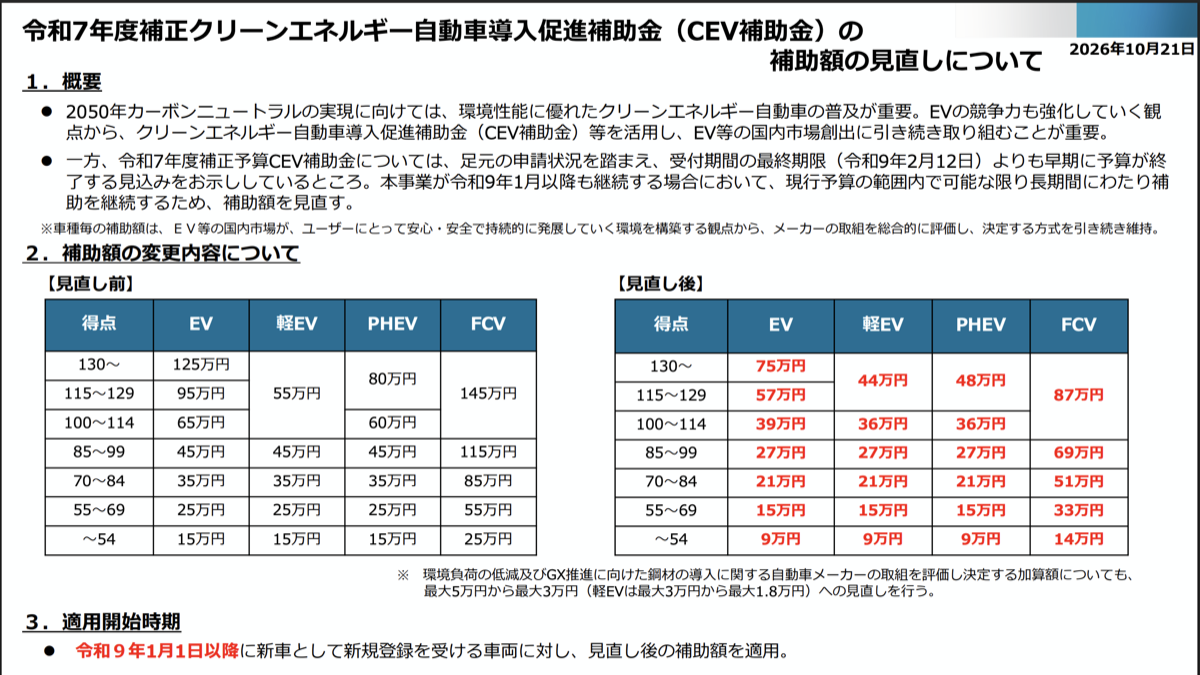
METI’s table (in Japanese) lists the subsidy cap for each score band, with the current amount next to the amount from January 2027.
- Regular-size EVs drop to 60% at every level (the top cap goes from ¥1.25 million to ¥750,000, about $8,300 to $5,000)
- For kei EVs (Japan’s smallest car class, limited to 3.4 m in length), the top cap goes from ¥550,000 to ¥440,000
- The GX bonus (extra money for things like using low-emission steel) also drops from up to ¥50,000 to ¥30,000 (¥30,000 to ¥18,000 for kei EVs)
How net prices change by model
The Next Generation Vehicle Promotion Center (the body that runs the subsidy) also published the January amounts for each model on the same day. Here is each model’s price minus the subsidy, now and from January.
Compact EVs
| Model | Battery (kWh) | Range (km) | Price (¥1,000) | Net now (¥1,000) | Net from Jan (¥1,000) | Rank |
|---|---|---|---|---|---|---|
| Hyundai INSTER Voyage | 49.0 | 477 | 3,355 | 2,885 | 3,073 | 1→1 |
| BYD DOLPHIN Long Range | 58.56 | 476 | 3,740 | 3,590 | 3,650 | 4→2 |
| Suzuki e VITARA Z 2WD | 61 | 520 | 4,488 | 3,218 | 3,726 | 2→3 |
| Nissan LEAF B5 X | 55 | 469 | 4,739 | 3,449 | 3,965 | 3→4 |
| Hyundai KONA Voyage | 64.8 | 616 | 4,521 | 4,051 | 4,239 | 5→5 |
Mid-size EVs
| Model | Battery (kWh) | Range (km) | Price (¥1,000) | Net now (¥1,000) | Net from Jan (¥1,000) | Rank |
|---|---|---|---|---|---|---|
| BYD ATTO 3 EX RWD | 74.88 | 620 | 4,378 | 4,228 | 4,288 | 4→1 |
| Subaru Solterra ET-SS FWD | 74.7 | 746 | 5,170 | 3,880 | 4,396 | 1→2 |
| Tesla Model 3 RWD | n/a | 594 | 5,313 | 4,043 | 4,551 | 2→3 |
| Toyota bZ4X Z FWD | 74.69 | 746 | 5,500 | 4,200 | 4,720 | 3→4 |
| BYD ATTO 3 EX AWD | 74.88 | 550 | 4,873 | 4,723 | 4,783 | 6→5 |
| Tesla Model Y RWD | n/a | 547 | 5,587 | 4,317 | 4,825 | 5→6 |
| BYD SEAL RWD | 82.56 | 640 | 4,950 | 4,800 | 4,860 | 7→7 |
| BYD SEALION 7 RWD | 82.56 | 590 | 4,983 | 4,833 | 4,893 | 8→8 |
| Volvo EX30 Ultra P5 | 69 | 560 | 5,790 | 5,430 | 5,574 | 10→9 |
| Nissan ARIYA B6 | 66 | 470 | 6,676 | 5,386 | 5,902 | 9→10 |
Kei EVs
| Model | Battery (kWh) | Range (km) | Price (¥1,000) | Net now (¥1,000) | Net from Jan (¥1,000) | Rank |
|---|---|---|---|---|---|---|
| Suzuki e SKY G | 26 | 310 | 2,390 | 1,822 | 1,940 | 1→1 |
| BYD RACCO 200 | 22.40 | 210 | 2,145 | 1,995 | 2,055 | 2→2 |
| Nissan Sakura X | 20 | 180 | 2,599 | 2,019 | 2,141 | 3→3 |
| Mitsubishi eK X EV G | 20 | 180 | 2,662 | 2,088 | 2,208 | 4→4 |
| BYD RACCO 300Plus | 35.84 | 320 | 2,398 | 2,248 | 2,308 | 5→5 |
| Honda N-ONE e: L | 29.6 | 295 | 3,199 | 2,619 | 2,741 | 6→6 |
To begin with, the kei EV ranking doesn’t change in January. I also included both versions of the BYD RACCO: the 200, which compares directly with the Nissan Sakura / Mitsubishi eK X EV twins (20 kWh), plus the larger-battery 300Plus. Also, the e SKY is a new model due on November 16.
How to read the tables
- Battery is the total capacity (kWh). Range is the catalogue figure for one charge (km, WLTC). Tesla doesn’t publish battery capacity
- All prices are in thousands of yen (¥1,000 is about $6.70). “Now” means registered from April 1 through December 31, 2026; “from Jan” means registered from January 1, 2027 onward. Each table is sorted by the net price from January
- Rank is the position by net price within each table, shown as “now→from Jan”. Highlighted rows move up the ranking from January
- Price is the list price (excluding tax) from the official list plus Japan’s 10% consumption tax. I compared well-equipped mid grades or higher rather than the cheapest entry grades
- Net price is the price minus the national CEV subsidy. However, local government subsidies are not included
- The Lexus RZ, UX and ES and the Honda INSIGHT also drop from ¥1.3 million to ¥780,000
- Checked against the Next Generation Vehicle Promotion Center’s per-model subsidy list (as of October 21, in Japanese)
Every regular-size EV drops to 60% of its current subsidy. Many kei EVs keep about 80%, so they lose a little less.
Models you can also buy outside Japan
For readers outside Japan, here are some models also sold in Europe and elsewhere, with the Japanese prices and subsidy amounts from the same list. Subsidy and price columns are in thousands of yen.
| Model | Price (¥1,000) | Subsidy now (¥1,000) | Subsidy from Jan (¥1,000) | Net now (¥1,000) | Net from Jan (¥1,000) | Increase (¥1,000) |
|---|---|---|---|---|---|---|
| Hyundai KONA Voyage | 4,521 | 470 | 282 | 4,051 | 4,239 | 188 |
| Hyundai IONIQ 5 Voyage | 5,236 | 870 | 522 | 4,366 | 4,714 | 348 |
| Volvo EX30 Ultra P5 | 5,790 | 360 | 216 | 5,430 | 5,574 | 144 |
| BMW iX1 eDrive20 M Sport | 6,780 | 680 | 408 | 6,100 | 6,372 | 272 |
| Volvo EX40 Ultra Single Motor | 7,190 | 360 | 216 | 6,830 | 6,974 | 144 |
| Mercedes-Benz CLA 250+ with EQ Technology | 7,750 | 980 | 588 | 6,770 | 7,162 | 392 |
| Mercedes-Benz EQA 250+ | 7,770 | 860 | 516 | 6,910 | 7,254 | 344 |
| BMW i4 eDrive40 M Sport | 9,220 | 850 | 510 | 8,370 | 8,710 | 340 |
| BMW iX3 50 xDrive | 9,820 | 544 | 326 | 9,276 | 9,494 | 218 |
In fact, even within one brand, the amount differs by model. The Hyundai KONA and the Volvos lose relatively little, but the IONIQ 5 gets ¥870,000 now, so it loses about ¥350,000 (about $2,300). Meanwhile, the Mercedes-Benz CLA has the largest subsidy in this group at ¥980,000, and it also drops the most.
Unlike the others, the BMW iX3 is priced above ¥8.4 million before tax, so its subsidy is already reduced to 80% under the scheme’s rules, and the January cut applies on top of that.
The Nissan LEAF dropped even further than planned
Back in March, reports said the Nissan LEAF’s subsidy would drop from ¥1.29 million to ¥1 million for cars registered from January 2027. With this cut, it falls further to ¥774,000.
The Suzuki e VITARA was also set to go from ¥1.27 million to ¥980,000 under the March plan, but it is now ¥762,000.
BYD and Hyundai become more competitive on price
Since 2024, the subsidy has been calculated not just from the car’s performance but also from the carmaker’s efforts. Since then, China’s BYD and Korea’s Hyundai have received much smaller subsidies, ¥800,000 to ¥1.15 million (about $5,300 to $7,700) less than Japanese brands and Tesla.
This time every car is cut by the same percentage, so the bigger the subsidy, the bigger the drop. Japanese brands plus Tesla go up by more than ¥500,000 (about $3,300). BYD goes up by only ¥60,000 (about $400). Hyundai’s KONA, like its INSTER, goes up by ¥188,000 (about $1,250).
How the price gaps change from January
As a result, the net price gaps change like this from January:
- BYD ATTO 3 EX vs Toyota bZ4X Z: the ATTO 3 EX is ¥28,000 more expensive now → ¥432,000 cheaper from January
- BYD ATTO 3 EX vs Tesla Model Y RWD: the ATTO 3 EX is ¥89,000 cheaper now → ¥537,000 cheaper from January
- ATTO 3 EX AWD vs Tesla Model Y RWD: the AWD is ¥406,000 more expensive now → ¥42,000 cheaper from January
- BYD DOLPHIN vs Suzuki e VITARA Z: the DOLPHIN is ¥372,000 more expensive now → ¥76,000 cheaper from January
- Hyundai KONA vs Nissan LEAF B5 X: the KONA is ¥602,000 more expensive now → ¥274,000 more expensive from January
- BYD SEAL vs Tesla Model 3: the SEAL is ¥757,000 more expensive now → ¥309,000 more expensive from January
Overall, among mid-size EVs, the ATTO 3 EX becomes the cheapest in net price from January. In other words, BYD and Hyundai, which have been at a disadvantage under the subsidy, become relatively more competitive on price.
BYD’s kei EV, the RACCO 200, is already ¥24,000 cheaper than the Nissan Sakura X in net price. From January, it’s ¥86,000 cheaper. Its battery is also a little bigger, at 22.40 kWh against the Sakura’s 20 kWh.
Registering this year or next can mean a ¥500,000 gap
For many regular-size EVs, registering this year rather than next year changes the subsidy by more than ¥500,000.
For example, the Tesla Model Y RWD gets ¥1.27 million if registered this year, for a net price of ¥4.317 million. Registered next year, it gets ¥762,000, for a net price of ¥4.825 million (about $28,800 vs $32,200).
That said, this year’s applications are expected to close sometime in December when the budget runs out. Even if you register this year, you’ll need to wait for an announcement on how cars registered after the budget runs out will be handled.
Media reports say the government intends to keep the subsidy going without a gap, for example by paying from next year’s budget retroactively once this year’s runs out. I couldn’t confirm this in METI’s documents yet, so I’ll wait for an official announcement.
Nikkan Jidosha Shimbun: METI announces CEV subsidy changes from January 2027 (in Japanese)
Summary
In short, EVs registered on or after January 1, 2027 will get roughly 60% of today’s Japan EV subsidy. For Japanese brands plus Tesla, the registration year alone can make a difference of more than ¥500,000. BYD and Hyundai, which received smaller subsidies, lose much less, so they become relatively more attractive in net price.
If you’re counting on the Japan EV subsidy for a purchase soon, it’s worth checking when you can register the car and whether applications are still open before you decide.
My own take: I think this announcement is part of the exit strategy for the CEV subsidy, meant to push carmakers to compete as EVs spread. But the subsidy has distorted prices so much until now that I’m worried some Japanese carmakers will be left behind.
As a user, I’m hoping for plenty of competition on price and technology, so that we end up with more EV choices!
I’ll write another article when new announcements come out.
This article is also available in Japanese.