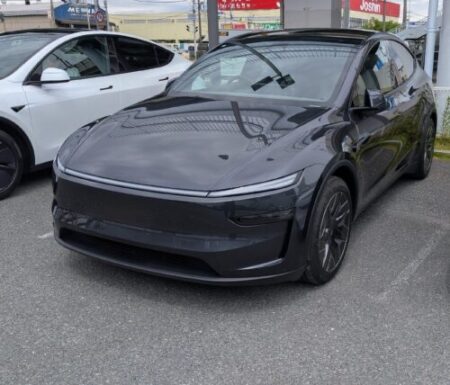
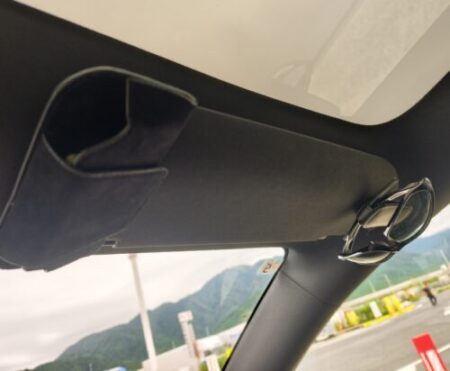
It has been almost two months since my Tesla Model YL was delivered.
The odometer has already passed 8,000 km (about 5,000 miles), yet the car is still scratch-free — a record I would very much like to keep.
Then came a scary moment on the expressway: highway debris, right in my lane. A wood plank came tumbling out from under the truck ahead of me—
Here is the dashcam video of how I dodged it, together with what the moment taught me about defensive driving.
The Overhead Sign Warned About Highway Debris
Driving on the Shin-Meishin Expressway, an electronic message board overhead caught my eye.
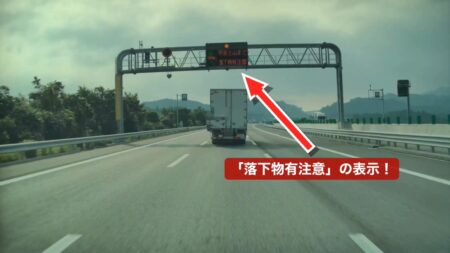
The LED sign (in Japanese) reads: “Watch out for fallen objects through the Koka-Tsuchiyama area.”
To be honest, I usually shrug these warnings off. “Sure, it happens.”
But this one stuck in my head that day. I kept a bit more following distance than usual, with my eyes further up the road. That paid off almost immediately.
The Warning Was Real: Dodging the Debris on Video
Moments after passing the sign, there it was.
By the way, the maneuver you are about to see is all manual driving — not FSD.
Here is the clip (16 seconds, no audio; the captions are in Japanese):
A wood plank was lying right in the middle of my lane.
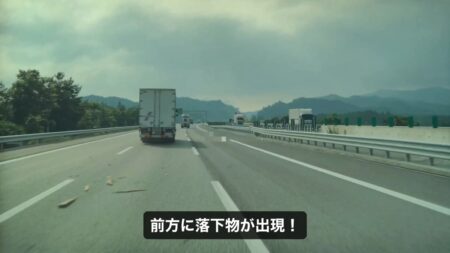
The on-screen caption says: “Debris ahead!”
Because it appeared from behind the truck in front, the gap had closed more than I expected by the time I could see it.
A quick mirror check, then a smooth move to the right within the lane. Missed it cleanly.
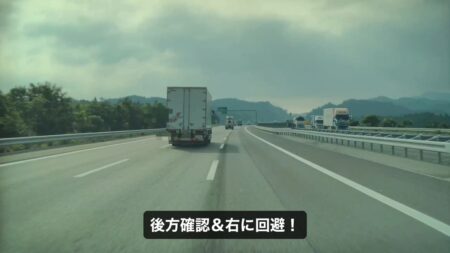
The caption reads: “Mirror check — dodge to the right!”
My own eyes, my own hands.
Impressed With the Model YL’s Handling
What struck me afterwards was how honest the Model YL felt through all of this.
Turn the wheel a little, the car moves exactly that much; straighten it, everything settles instantly. For a large three-row SUV, there was no wallowing at all, even with a near-emergency input.
I suspect the low center of gravity from the floor-mounted battery deserves much of the credit. Having that kind of margin “when it counts” is genuinely reassuring.
Two months of ownership, 8,000 km on the clock, still unscratched. The last thing I wanted was to shred a tire on a plank of wood — so, relief.
Takeaways: Why This Dodge Worked
Looking back, the Model YL’s handling helped, but the bigger factor was that the warning sign had me primed.
- The message board planted the idea that something might be on the road
- Extra following distance bought me time between spotting the plank + steering away
- With the truck blocking my view, I had already mirror-checked whether the space beside me was open
- The car responded exactly as asked
If any one of those had been missing, I would probably have hit it.
Following distance above all. Glued to the truck’s bumper, I would have had zero time once the plank appeared.
It reads like a split second in text; watch the video to feel how little time there actually was.
One more thought: FSD is rumored to launch in Japan soon. My car already got smarter once with its first OTA update, so I keep wondering — would Tesla’s FSD spot a plank like this, then slide around it just as smoothly?
Half expectation, half excitement. Once it arrives here, that is exactly the kind of real-world skill I want to test.
Until then, I will keep reading those highway debris warnings, predicting what might be ahead, with a healthy gap to the car in front.
The other tyre habit I have picked up since: hooking trapped stones out of the tread with a tool that costs about as much as a coffee.
This article is also available in Japanese.